

There are lives that begin in silence, far from privilege or promise, and yet rise to shape the world’s imagination. Omar Mwannes Yaghi’s life is one of them.
Born in 1965 in Amman, Jordan, to a Palestinian refugee family displaced from Gaza, his early years unfolded in a small, crowded home in a refugee camp where water was rationed and light was a luxury. The walls were thin, the air often heavy, but within that modest space grew a boy whose curiosity burned brighter than any lamp.
He would rise before dawn to fill containers before the pipes ran dry, then sit by a flickering bulb to read until sleep overtook him. His parents, who could barely read or write, taught him about the importance of education. They had lost their homeland, but they would not lose the belief that knowledge could one day redeem their children’s future.
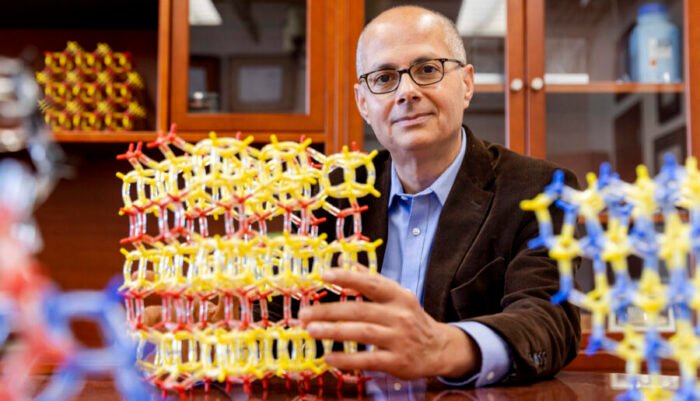
One afternoon, in a small public library, Omar’s young eyes caught sight of a ball-and-stick model of a molecule. Its quiet symmetry entranced him. Here was an invisible world made visible, a harmony of atoms bound in grace. It was not simply a scientific curiosity; it was beauty made tangible. That moment planted in him a lifelong yearning: to understand, to build, to give form to the unseen.
When he was a teenager, Yaghi left for the United States. A boy alone, crossing oceans for the promise of education. He arrived with halting English, no high-school diploma, and pockets as empty as his ambition was full. He found work in a supermarket by day and studied at Hudson Valley Community College by night. There were moments of loneliness so sharp they bordered on despair, yet he pressed on.
From community college, he transferred to the University at Albany, where he earned his bachelor’s degree in chemistry, and then to the University of Illinois at Urbana–Champaign for his Ph.D. Each step forward was an act of will. Each degree, a brick in the invisible architecture of perseverance. He would go on to Harvard as a postdoctoral fellow; but his heart never forgot the humility of those early days, sweeping supermarket floors and studying between shifts.
In the quiet of his laboratory, Omar Yaghi began to imagine chemistry not as discovery but as creation. Nature, after all, had already offered its designs; what if the human mind could make new ones? From that daring thought emerged reticular chemistry, a field he pioneered, one that allows scientists to link metal ions and organic molecules into intricate crystalline frameworks.
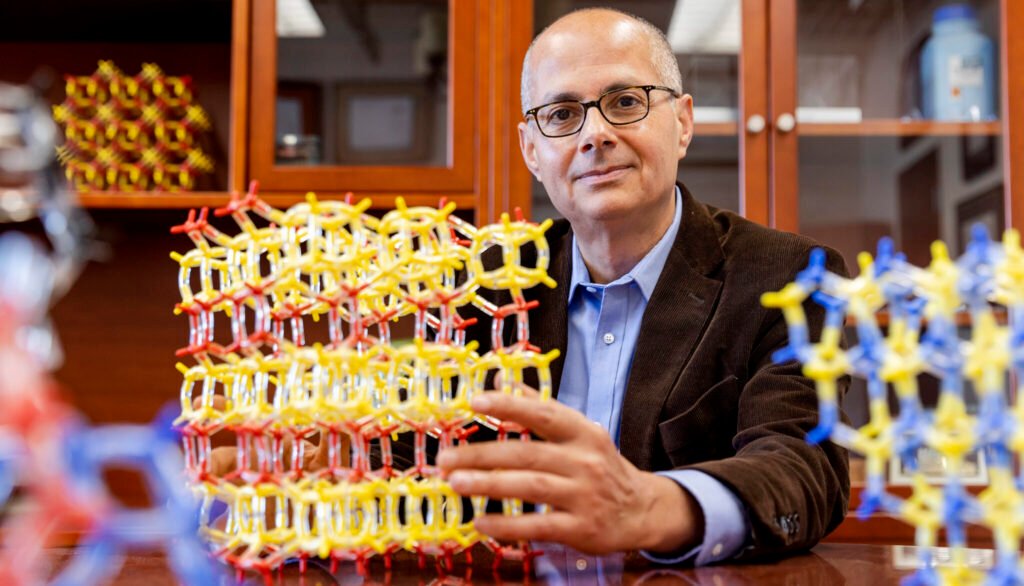
These metal–organic frameworks, or MOFs, are vast and porous at the molecular level—tiny cathedrals built of atoms, with inner spaces large enough to hold gases, water, or even the dreams of future technologies. A single gram of a MOF can have the surface area of multiple football fields. Through them, Yaghi showed that chemistry could be architectural, that we could construct, not merely observe, the material of the world.
He often described this process as designing with building blocks at the molecular scale. But the deeper truth was this: his structures were born not from nature, but from imagination. He had conjured order out of emptiness, lattice by lattice, atom by atom.
Over decades, he elaborated ever more precise synthesis rules: how to ensure the frameworks are stable, maintain porosity, allow the passage of gases, and resist collapse. He also extended the concept to covalent organic frameworks (COFs) and molecular weaving, creating structures held together by strong covalent bonds and even woven at molecular scales. Because his frameworks are synthetic constructions, designers can tailor them—changing linkers, pore sizes, chemical affinities. In practice, that has led to remarkable applications: harvesting water from arid air, capturing carbon dioxide, filtering pollutants, storing hydrogen, catalyzing reactions, and more.
In short, Yaghi was not merely a scientist who explored molecular structures. He was one who created the very space of possibilities that molecular structures could unfold. And through his research, a new pathway has opened to mitigate the global environmental crisis caused by carbon dioxide.
In 2012, he joined the University of California, Berkeley, a place he calls “the nirvana of science.” Indeed, Berkeley is famed for its scientific lineage: over 120 Nobel laureates are affiliated as alumni, faculty, postdocs, or visiting professors/researchers. Becoming part of that community is itself a dream fulfilled for someone born in exile and poverty. There, surrounded by brilliant colleagues and students, he continues his mission: to explore the limits of matter and to mentor those who may one day surpass him.
On October 8, 2025, that journey came full circle when Omar Yaghi was awarded the Nobel Prize in Chemistry, alongside Susumu Kitagawa and Richard Robson, for creating new molecular architectures through MOFs. When he reflected on the honor, he spoke with characteristic humility, saying he had always set out simply to build beautiful things and solve intellectual problems.
Omar Yaghi’s journey reads like an allegory of modern hope. His story tells every student, every dreamer, every child who studies by dim light like he once did: your circumstances do not define you; your curiosity does.
In the end, from the narrow streets of Amman to the luminous laboratories of Berkeley, Yaghi’s life forms its own kind of molecular framework, a lattice of love, labor, and limitless mind. And within that invisible structure lies the enduring truth of his journey: that even in a world built of atoms, it is the human spirit that holds everything together.