

The Origins of the Korean People
The history of the Korean people begins long before written records, reaching back to the Paleolithic age. Archaeological research shows that humans began living on the Korean Peninsula hundreds of thousands of years ago, during a time when the earth’s climate shifted repeatedly between cold glacial periods and warmer interglacial periods. Every change in the sky and sea shaped the way early people lived.
During the major glacial periods, large portions of the Northern Hemisphere were covered by thick ice sheets. Because so much water was locked in ice, sea levels in East Asia were far lower than they are today. As a result, the Chinese continent, the Korean Peninsula, the Japanese islands, and Taiwan were all connected by continuous stretches of land. Early humans and animals moved freely across these regions, long before the seas rose and separated them.
When the Ice Age ended and global temperatures rose, the glaciers melted and sea levels increased. The shorelines bent into new shapes, slowly becoming the ones we recognize on today’s maps. The Korean Peninsula emerged as a distinct geographical region, connected to the continent in the north, bordered by the sea to the east and west, and facing Japan across the Korea Strait to the southeast. This land would become the primary homeland of the Korean people.
Archaeological and linguistic research indicates that the ancestors of the Korean people settled in the Korean Peninsula and Manchuria from very early times. Over many generations, they developed a distinct culture and identity. They belonged to the Mongoloid racial group and spoke a language classified within the Altaic family, roots that extend into the present-day Korean ethnic and linguistic identity.
The Paleolithic people of Korea made simple stone and bone tools. Early tools were made by chipping stones into sharp edges, but over time these early humans developed more specialized implements. Hand axes, choppers, and pointed tools were used for hunting, while blades, scrapers, and burins allowed them to prepare food and process materials. Stone hammers and engraving tools helped them produce wooden and bone tools suited to their needs.
Their daily life was shaped by the world around them. Paleolithic people hunted animals, caught fish in rivers and streams, and gathered fruits, nuts, and edible roots. They lived in caves or in temporary huts near water sources. In some sites, they left carvings of animals on bone or stone—simple markings that may reflect early ritual practices or hopes for successful hunts.
Much later, around 8000 BCE, Korea entered the Neolithic age, with the appearance of polished stone tools and pottery. Neolithic people produced a variety of tools: stone axes, stone spears, arrowheads, and bone implements such as fishhooks. Early pottery was plain or decorated with added patterns, but later evolved into the distinctive comb-pattern pottery. These vessels, with parallel lines carved across wide surfaces and pointed bases shaped like halved eggs, represent the most characteristic artifact of this era. Their designs grew more complex and refined over time.
Neolithic sites appear throughout the Korean Peninsula, especially along major rivers and coastal regions. Important archaeological locations include Amsa-dong in Seoul, Dongsam-dong in Busan, Osan-ri in Yangyang. Together, these sites reveal a widespread and well-developed Neolithic culture.
Neolithic communities lived close to rivers and the sea, where they could fish with bone hooks and nets and hunt with spears and arrows. They continued gathering fruits and edible roots, but over time they began cultivating crops and raising livestock. Using stone hoes, they farmed millet and other grains, harvested them with stone or bone sickles, and ground the grain on stone slabs. They spun thread with spindle whorls, wove cloth, and sewed clothing with bone needles.
Their homes were pit dwellings, which were houses dug into the ground, roofed with earth, wood, and straw. People sharing the same lineage gathered into clans, and several clans formed tribes. These early communities were often led by experienced elders who oversaw farming and other productive activities.
Reconstructed Neolithic pit dwellings based on archaeological findings (Amsa-dong in Seoul)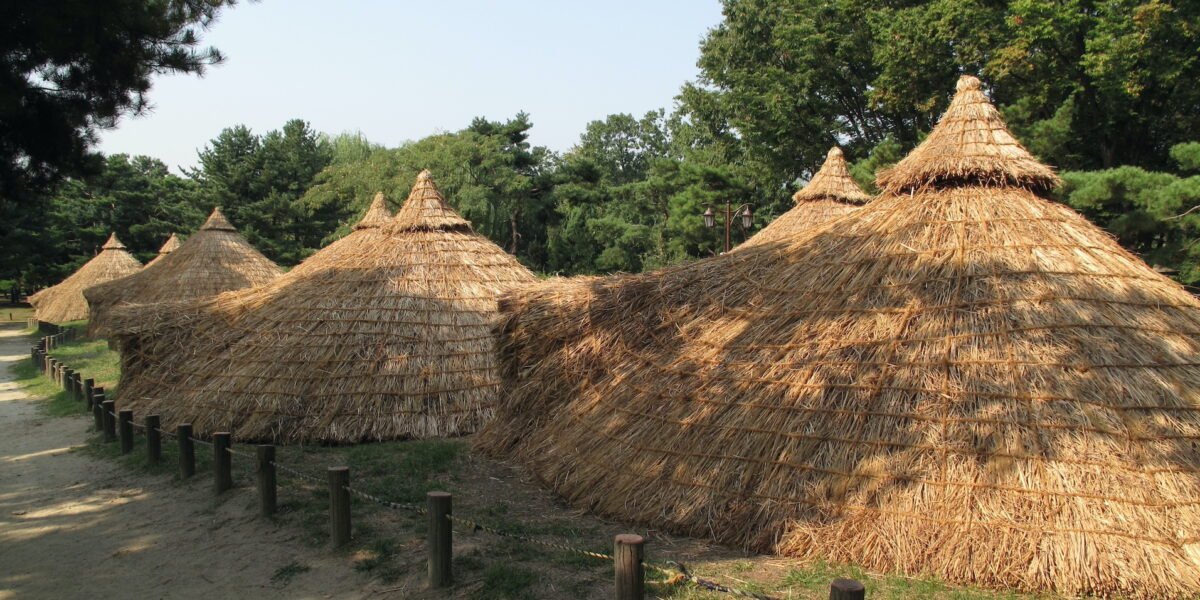
Neolithic people believed that the world was alive with spirits. They saw spiritual power in the sun and moon, mountains and rivers, animals and great trees. Some tribes worshiped specific animals as protective guardians. These beliefs shaped early ritual practices and gave rise to forms of artistic expression that continued to develop in later Korean history.