
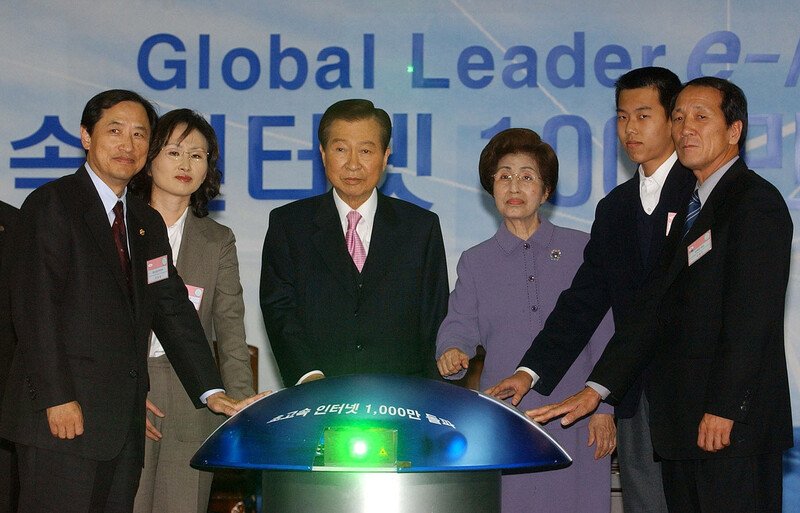
In the late 1990s, even as the aftershocks of the IMF financial crisis still hung heavily over the nation, President Kim Dae-jung launched a national strategy to transform Korea into an Internet powerhouse. His focus on building fiber-optic networks, expanding Internet access, and positioning Korea as a global leader in information technology was not merely about informatization. It was a deliberate effort to establish the very foundation of national competitiveness. At the time, few could have imagined that Korea’s fast and accessible Internet infrastructure would come to reshape the nation itself and the daily lives of its people, yet Kim’s foresighted investment laid the cornerstone for Korea’s rise as a global leader in digital capacity and network technology.
In that context, President Lee Jae-myung’s current AI-centered initiative bears a clear resemblance to that earlier moment in history. The difference lies in its focus. This time it’s not on the Internet network, but on the computing network, data infrastructure, and AI application ecosystem. The Lee administration’s goal is not merely to become a country proficient in a single technology called AI, but to build a national AI hub where infrastructure, demand, capital, and ecosystem are organically interconnected. Upon this foundation, Korea seeks to stand at the forefront of the AI era and, through the transformative reach of innovation, regain its lost momentum of growth and usher in a new wave of economic revival.
The framework of the Lee administration’s AI strategy rests on three central pillars: focused investment, institutional reform, and public–private collaboration. More concretely, its main axes can be outlined as follows:
First, AI data centers face two major bottlenecks: power supply and cooling. The government aims to ease these constraints by developing large-scale data center clusters, streamlining power-related permitting processes, and refining the renewable energy PPA (Power Purchase Agreement) system. The memorandum of understanding signed with BlackRock is part of this effort to establish a cooperative framework linking AI and renewable energy infrastructure.
Seoncd, the administration plans to expand the National Growth Fund, integrate public financing with private capital, and create dedicated financial mechanisms to support strategic AI industries. At the heart of this agenda is the goal of attracting global institutional investors to mobilize large-scale funding for the sector.
Third, R&D and pilot investments are being concentrated on processing chips, AI accelerators, memory (particularly HBM), and advanced packaging technologies. The government is expected to form public–private consortia to strengthen vertical collaboration across the chip–memory–packaging chain.
Fourth, efforts are underway to enhance AI foundational research at universities and institutes, establish stronger AI ethics and governance systems, and design retraining and upskilling programs that align with industry needs.
Finally, expanding ties with corporations and public institutions that have high AI application demand is essential. Only with robust demand for data and platforms can Korea’s semiconductor and infrastructure sectors sustain long-term growth.
Within the broader trajectory of Korea’s AI policy, President Lee’s late-September meeting in New York with BlackRock CEO Larry Fink, which was held during his visit to the UN General Assembly, carried considerable symbolic weight. The two leaders went beyond mere formality and signed an MOU on cooperation in AI and renewable-energy infrastructure. Given that BlackRock manages the world’s largest pool of institutional capital, the meeting signaled far more than a diplomatic courtesy; it was a strategic message to global investors that Korea intends to draw international capital into its AI infrastructure drive.
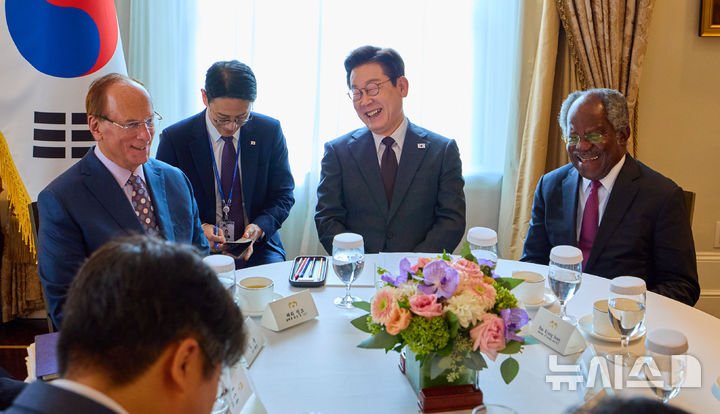
Although the scale and specific projects under the MOU have yet to be finalized, both sides agreed to establish a joint task force to develop concrete implementation plans. The encounter between President Lee and Fink effectively declared the government’s intention to take the lead not only in policymaking but also in the capital domain.
The Lee administration is not content to act as a policy designer alone; it aims to operate through a three-tier leverage model of policy, capital, and execution, aligning financial muscle with national strategy.
A few weeks later, President Lee met with OpenAI CEO Sam Altman in Seoul to strengthen the link between the demand side of the AI industry and Korea’s technological ecosystem. The two discussed a wide range of topics, including AI applications and collaboration, integration with the semiconductor supply chain, and the expansion of platform-driven demand. On that day, the possibility of cooperation with leading domestic semiconductor firms such as Samsung and SK also surfaced.
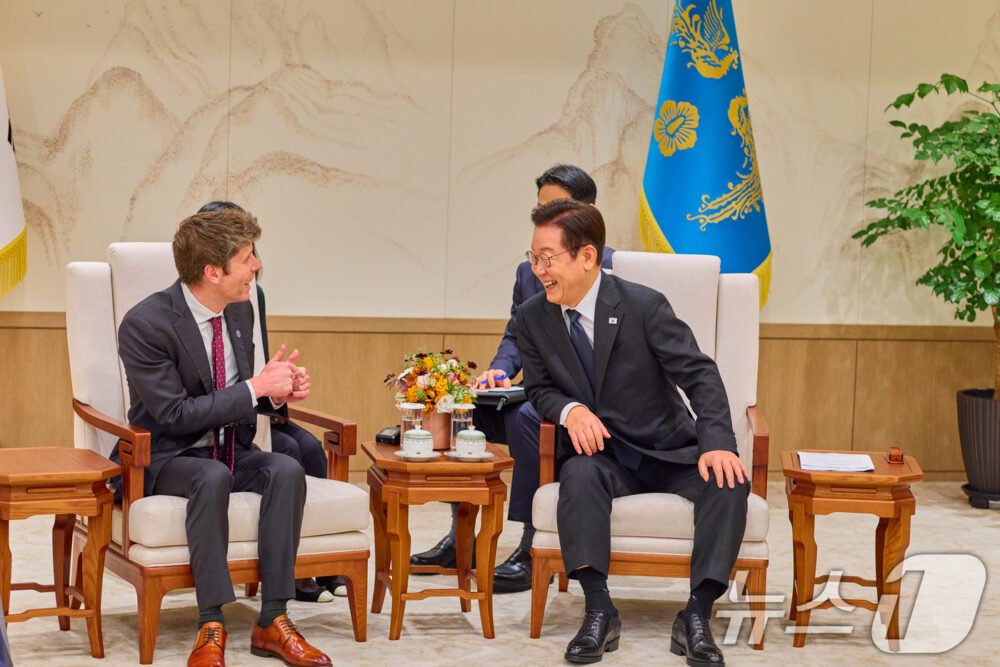
This meeting was significant for several reasons. First, OpenAI represents the demand side of the AI model ecosystem. Collaboration with Korean companies and platforms offers the possibility for Korea to move beyond the role of manufacturer toward that of co-designer and joint architect of AI applications. Second, the meeting opened direct channels for Korean semiconductor, memory, and packaging firms to align themselves with the expanding global demand for AI infrastructure. Finally, a direct conversation between the OpenAI CEO and the Korean president served as a clear message that Korea intends to project its AI policy ambitions onto the global stage.
President Lee Jae-myung also played a pivotal role in sparking NVIDIA’s major GPU supply agreement with South Korea. The company has promised that more than 260,000 of its latest Blackwell-generation GPUs will be provided to the Korean government and leading corporations from 2026 to 2030. NVIDIA CEO Jensen Huang was notably influenced by President Lee’s ambition to make South Korea the AI capital of the Asia-Pacific region by pledging substantial governmental funding and institutional support.

During their meeting at the APEC Summit in Gyeongju, President Lee remarked, “If NVIDIA is responsible for the speed of AI innovation, Korea is the optimal partner to utilize this speed effectively and suggest the right direction for innovation.” From Huang’s perspective, such large-scale commitment in a nation with deep manufacturing capacity and bold AI ambition presented a clear win: access to a robust partner ecosystem, rapid scalability, and reduced exposure to geopolitical risks, particularly those linked to China. In the end, it was a decisive victory for both sides.
President Lee’s ambition is to make Korea the world’s leading AI power, along with the United States and China. The strongest force capable of turning President Lee’s vision into reality lies in Korea’s twin pillars of the semiconductor industry, SK Hynix and Samsung Electronics, both of which possess world-class expertise in memory and packaging technologies. Among these, HBM (High Bandwidth Memory) stands as a critical component for relieving the bottlenecks in AI computation. As large-scale models expand and processing demands soar, conventional DRAM can no longer sustain the required bandwidth or latency; HBM, therefore, has become the indispensable fuel of the AI era.
In the global HBM market, SK Hynix currently leads in both technology and market share, while Samsung is aggressively pursuing the gap through the development of HBM3E and next-generation HBM4, alongside major production-line expansions. Both firms have been linked to participation in the “Stargate” global AI infrastructure project, where their roles could extend beyond memory supply to include packaging collaboration and chip-design integration.
If SK Hynix and Samsung together consolidate their leadership in HBM, Korea will move beyond the status of a mere memory supplier to become a core hub connecting AI platforms and applications. Their dynamic mix of competition and synergy will continue to serve as the heartbeat driving the nation’s AI ecosystem forward.
Investors, especially from abroad, have poured money into Korea on the belief that Lee Jae-myung’s vision and policies could transform the country into a global AI hub. Shares of Samsung Electronics and SK Hynix surged sharply, fueling momentum across the broader market. The benchmark KOSPI index recently broke the 4,000 threshold, closing at 4,221.87 on Novermber 03, 2025, its highest level ever recorded. This record-breaking run reflects more than just tech optimism; it signals a broader conviction that Korea’s structural shift toward AI could become a powerful engine of sustained economic growth and returns.
I believe in President Lee’s vision. I am confident that within the next three to five years, Korea will rise to become one of the world’s top AI powers. And twenty-five years from now, we will look back and say this: just as President Kim Dae-jung transformed the structure of the nation through the digital revolution of the 1990s, President Lee Jae-myung’s vision in 2025 ushered Korea into the ranks of the world’s leading AI nations.