
(*English version at the bottom)
중국을 향한 꿈, 원주민의 악몽: 콜럼버스의 유산
원주민들의 평화는 유럽인의 유입으로 서서히 깨지기 시작했다. 일반적으로 아메리카 대륙을 처음 발견한 유럽인은 크리스토퍼 콜럼버스로 알려져 있지만, 사실 그보다 500년 앞서 북대서양을 건넌 바이킹들이 북아메리카에 작은 개척지를 세운 바 있었다.
신대륙에 처음 발을 디딘 유럽인은 비욘(Bjorn)이라는 바이킹으로 전해진다. 그는 서기 986년, 항해 도중 우연히 오늘날 매사추세츠 주의 케이프 코드 만을 발견했다. 그러나 진정한 의미의 첫 개척자는 리프 에릭손(Leif Erikson)이었다. 그의 가문은 결코 평범하지 않았다. 살인죄로 아이슬란드에 추방된 노르웨이인 할아버지는 불운한 흔적을 남겼고, 아버지 에릭 ‘붉은 수염’은 그 가족의 추방을 오히려 기회로 바꾸어 그린란드를 탐험하고 지배하였다.
1001년, 리프는 아버지의 명령을 받고 그린란드에서 항해를 시작해 오늘날 캐나다 뉴펀들랜드 지역에 정착지를 세웠다. 그러나 북아메리카에서 그린란드와 연락을 유지하기는 무척이나 어려웠다. 아버지가 세상을 떠나자, 그는 홀로 개척지를 지켜내기에는 역부족이라 판단하여 결국 철수하고 그린란드로 돌아갔다.
이후 아이슬란드 출신의 또 다른 바이킹, 똘피누르(Thorfinnur, 또는 Thorfinn)가 가족과 동료들(130명, 3척의 배)을 이끌고 1004년에 리프의 개척지로 건너갔으나, 머지않아 다시 그린란드로 돌아갔다. 이렇게 바이킹들의 개척 시도는 오래가지 못했다. 그리고 리프와 똘피누르의 이야기는 유럽 사회에 알려지지 못한 채 역사 속에 묻혀버렸다.
바이킹들의 주요 항해 경로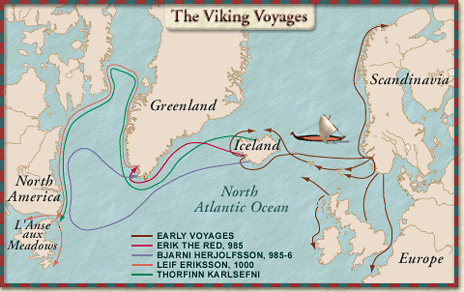
캐나다 뉴펀랜드에는 아직도 바이킹들의 흔적이 남아있다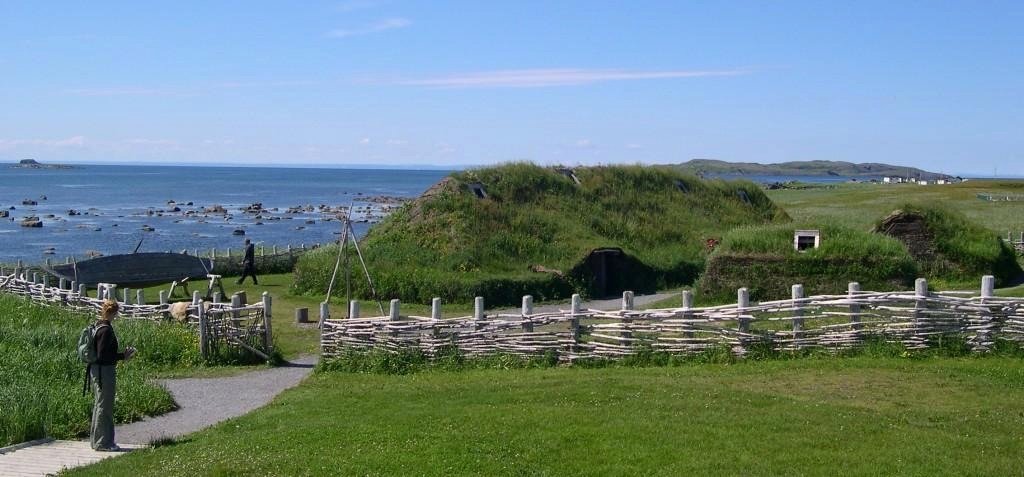
500년 뒤 콜럼버스가 신대륙을 향해 항해를 시작했을 때, 그 역시 바이킹들의 이른 개척을 알지 못했다. 설사 알았다 하더라도 개의치 않았을 것이다. 왜냐하면 콜럼버스가 찾고자 했던 것은 신대륙이 아니라 중국이었기 때문이다.
콜럼버스는 1451년 이탈리아 북서부의 항구 도시 제노바에서 태어났다. 그는 어려서부터 독서에 몰두했으며, 특히 마르코 폴로를 비롯해 중국과 인도를 다녀온 사람들의 기록에 매혹되었다. 이러한 영향으로 그는 서쪽 바다를 건너 아시아 대륙에 도달할 수 있다는 꿈을 키웠다. 그는 아시아가 대서양 바로 건너편에 있으리라고 믿었다.
1484년, 콜럼버스는 자신의 계획을 당시 조선업과 항해술이 가장 발달한 나라였던 포르투갈의 국왕 주앙 2세(D. João II, 재위 1481~1495)에게 제안했다. 주앙 2세 역시 항해에 관심이 많았다. 하지만 그의 눈은 대서양 너머보다는 아프리카 남단을 돌아 아시아로 가는 항로에 더 쏠려 있었다. 물론 주앙 2세는 당시 아프리카 대륙의 거대한 규모를 상상조차 하지 못했지만 말이다. 그러나 결국 1488년 바르톨로메우 디아스(Bartolomeu Dias)가 그의 후원을 받아 희망봉(Cape of Good Hope. 아프리카 대륙 최남단으로, 유럽에서 아시아로 가는 항로 개척의 전환점이 된 곳)을 발견하면서 포르투갈의 항로 개척은 결실을 맺었다.
포르투갈에서 뜻을 이루지 못한 콜럼버스는 스페인으로 향했다. 당시 스페인은 이사벨라 여왕(재위 1474~1504. 카스티야 왕국의 군주로 아라곤 왕국 국왕 페르디난드 2세와의 통혼을 통해 스페인을 통일의 길로 이끈 인물)의 통치 아래 세력을 확장하던 시기였다. 그러나 이사벨라 여왕은 당시 무어인(이슬람교를 신봉하며 이베리아 반도 남부를 지배했던 북아프리카계 민족)과의 전쟁에 집중하고 있어, 처음에는 콜럼버스의 제안에 큰 관심을 두지 않았다.
콜럼버스는 끈질기게 설득했다. 중국에 가서 상상조차 할 수 없는 양의 금과 비단을 가져오겠다는 그의 약속에 여왕은 차츰 마음을 열었다. 더욱이 강력해지는 포르투갈의 영향력을 견제하기 위해서라도, 스페인 또한 새로운 항로 개척이 필요하다고 판단한 이사벨라 여왕은 마침내 콜럼버스에게 재정적 지원을 허락했다.
1492년 8월, 콜럼버스는 세 척의 배에 꿈을 가득 싣고 서쪽을 향해 항해를 시작했다. 그러나 그는 대서양의 거리를 잘못 계산했고, 식량과 물이 빠르게 고갈되었다. 33일간의 고된 항해 끝에 그가 도착한 곳은 중국이 아니라 오늘날의 바하마 제도였다. 플로리다 남동쪽 바다에 있는 작은 섬들이다.
자신이 신대륙에 도착했다는 사실을 전혀 알지 못한 채, 콜럼버스는 중국의 보물들을 찾기 시작했다. 그러나 그가 만난 사람들은 중국인이 아니라 1장에서 언급한 원주민들이었다. 콜럼버스는 자신이 인도(India)에 도착했다고 착각하고 그들을 “인디언(Indians)”이라 불렀다.
중국에 가까이 왔다고 믿은 그는 더 많은 인원과 물자를 얻기 위해 스페인으로 돌아갔다. 그 후, 세 차례 더 항해를 시도했지만 끝내 그토록 찾고자 했던 금과 비단을 발견하지 못했다. 1506년, 그는 자신이 발견한 땅이 중국에서 지구의 절반이나 떨어진 신대륙이라는 사실을 알지 못한 채, 병들고 스페인 왕실과의 고된 법적 분쟁 속에서 꿈을 이루지 못하고 생을 마쳤다.
콜럼버스의 항해 경로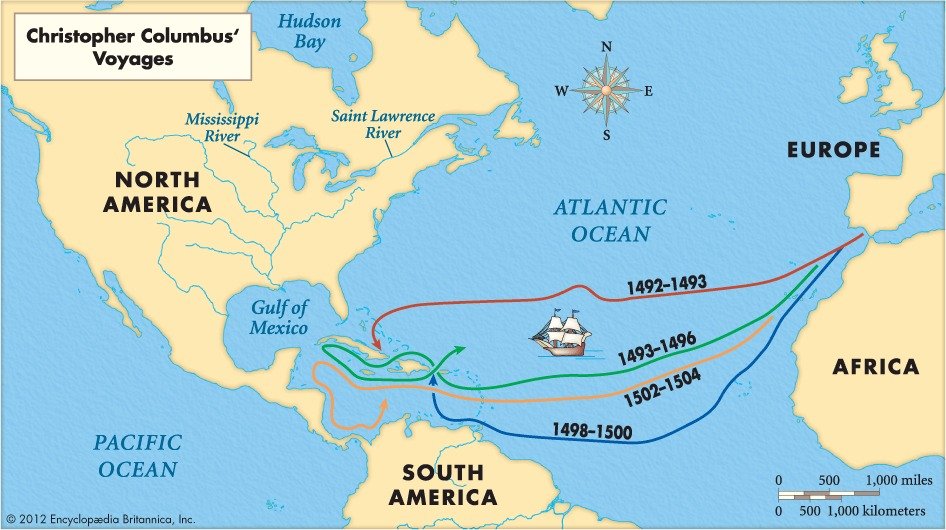
콜럼버스는 흔히 “신대륙을 발견한 영웅”으로 기억되지만, 역사 기록은 그의 또 다른 얼굴을 드러낸다. 그와 그의 부하들은 아메리카 원주민들을 노예화하고, 극심한 폭력과 잔혹한 처벌을 가했다. 첫 항해에서 만난 타이노(Taino)족은 그 피해가 특히 컸다. 콜럼버스는 원주민들을 금광과 농장에서 강제로 일하게 했다. 금 채굴 할당량을 채우지 못한 사람들은 손이 잘리는 끔찍한 형벌을 받았다. 수천 명을 스페인으로 끌고 가 노예로 팔았으며, 어린 소녀들은 성적 노예로 팔려나갔다.
히스파니올라 섬(오늘날의 아이티와 도미니카 공화국)에서 타이노족이 저항하자, 콜럼버스는 무자비한 탄압을 명령했다. 수많은 원주민들이 살해당했고, 잘려나간 시신이 거리에서 경고로 전시되었다. 여기에 유럽에서 전해진 천연두와 홍역 같은 전염병까지 겹치면서, 타이노족은 수십 년 만에 거의 자취를 감추게 되었다.
그렇다면 이러한 기록들은 얼마나 신뢰할 수 있을까? 역사가들은 신뢰할 수 있다고 말한다. 왜냐하면 콜럼버스와 총으로 무장한 스페인 정착민들의 잔혹 행위를 기록한 증언들이 단일한 목소리가 아니라 여러 독립적인 출처에서 전해지기 때문이다.
우선 바르톨로메 데 라스 카사스(Bartolomé de las Casas)가 있다. 그는 한때 신대륙 정복에 참여했던 스페인 식민자이자 수도사였지만, 이후 열렬한 콜럼버스 비판자가 되었다. 1540년대에 쓴 『서인도 파괴에 관한 짧은 보고』에서 그는 자신이 목격한 잔혹 행위를 상세히 기록했다. 비록 원주민 당사자는 아니었지만, 현장에서 직접 본 사건들을 남겼다는 점에서 그의 증언은 무게를 지닌다.
프란시스코 데 보바디야(Francisco de Bobadilla) 역시 중요한 목소리다. 그는 1500년 스페인 왕실이 파견한 행정관으로, 콜럼버스의 히스파니올라 통치를 조사했다. 원주민과 정착민 모두로부터 광범위한 증언을 수집했는데, 그 내용은 콜럼버스의 잔혹성과 통치 실패를 여실히 드러냈다. 그의 보고서는 결국 콜럼버스를 쇠사슬에 묶어 스페인으로 송환하게 만든 계기가 되었다.
무엇보다도, 콜럼버스 자신의 기록 역시 이러한 증언을 뒷받침한다. 그는 첫날 항해 일지에 타이노족을 “훌륭한 하인감”이라고 적고 여섯 명을 붙잡아 스페인으로 보낼 것을 명령했다. 이후 편지들에서도 원주민들을 노예로 팔 수 있다는 가능성을 거듭 언급했다.
그 외에도 그의 부하들의 기록이 남아 있다. 예컨대 미켈레 다 쿠네오(Michele da Cuneo)는 콜럼버스의 두 번째 항해에서 원주민 여성을 선원이 강간한 사건을 구체적으로 묘사했다. 이처럼 다양한 출처가 서로를 보완하며, 당시의 실상을 입체적으로 증언한다.
물론 역사는 흑백으로 단정할 수 없다. 우리는 결국 과거로부터 남아 있는 몇 가지 1차 사료에 의존해 역사를 판단할 수밖에 없다. 그렇기에 콜럼버스가 정말 그렇게 끔찍한 인물이었는지에 대해서는 오늘날 역사학자들 사이에서도 다양한 의견이 존재한다. 그러나 콜럼버스와 그의 부하들이 원주민들을 잔혹하게 착취했다는 사실을 의심할 수는 있겠지만, 그가 남긴 편지와 기록만 보더라도 원주민들을 동등한 인간으로 보지 않았다는 점은 분명하다. 특히 그들을 노예로 팔아 큰 이익을 얻을 수 있다고 쓴 글만 보아도, 그가 원주민들을 가혹하게 지배했으리라는 추정에 반론을 제기하기는 어렵다. 설령 그의 손으로 직접 모든 폭력이 이루어지지 않았다고 하더라도, 그의 통치 아래 그런 폭력이 광범위하게 벌어졌다는 사실은 변하지 않는다. 즉, 그가 집행자가 아니었을지언정 묵인자였음은 확실하다.
일부 역사학자는 콜럼버스를 “노예무역의 아버지(father of the slave trade)”라 부르기도 한다. 그는 원주민 노예제를 시작했을 뿐 아니라, 1501년 히스파니올라 총독직의 마지막 해에는 그의 착취로 인해 줄어드는 원주민 인구를 대신해 아프리카에서 흑인 노예를 들여오는 제도가 만들어졌다. 이것이 아메리카 대륙으로 흑인 노예들이 본격적으로 유입되는 시초가 되었으며, 이후 수백 년간 북미와 중남미 전역을 휩쓴 비극의 서막이 되었다.
따라서 오늘날 우리가 “위대한 발견”으로 기억하는 콜럼버스의 항해는, 동시에 원주민 세계의 파괴와 고통의 서막이었다. 그의 이름은 한때 영웅의 신화로 기려졌지만, 역사 기록이 들려주는 또 다른 이야기 속에서 그는 정복과 학살, 그리고 노예무역의 서슬 시퍼런 그림자를 남긴 인물로 자리한다.
콜럼버스 초상화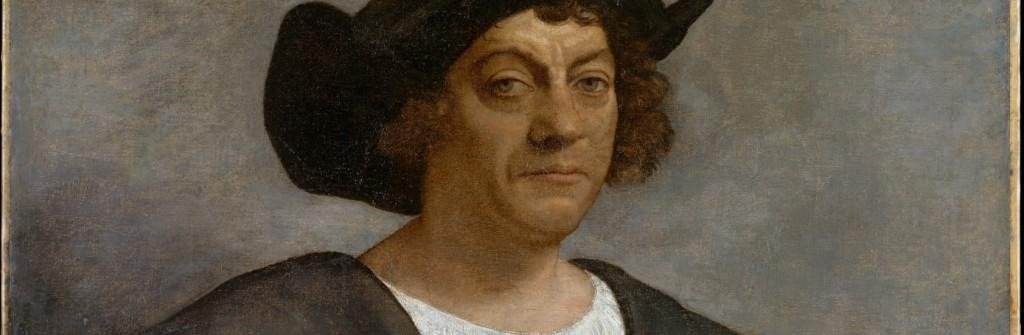
흥미롭게도, 콜럼버스가 도착한 땅이 아시아가 아니라 새로운 대륙임을 간파한 인물이 있었다. 그는 1499년 스페인의 후원 아래 항해를 떠나 오늘날 수리남에 도착했고, 1501년에는 포르투갈의 지원을 받아 지금의 브라질 해안을 탐험했다. 1502년 유럽으로 돌아온 그는 자신의 항해와 탐험을 화려하고 장황하게 서술한 책들을 출간했다. 글 속에서 마치 자신이 배의 지휘관인 양 묘사했지만, 실제로는 항해 경험이 미미했기에 많은 부분이 과장된 것이었다.
특히 그가 쓴 것으로 알려진 편지에는 자신이 1497년에 처음으로 남아메리카에 도달했다고 주장하는 내용이 담겨 있었다. (참고로 콜럼버스는 1498년 세 번째 항해 때 남아메리카 북부 해안에 발을 디뎠다.) 나중에 이 편지는 위조된 것으로 판명되었지만, 당시 유럽인들은 이를 사실로 받아들였고, 베스푸치가 콜럼버스보다 먼저 신대륙에 도착한 것으로 널리 알려졌다. 콜럼버스가 이미 1492년 첫 항해에서 오늘날의 북미 바하마에 도착했음에도 불구하고 말이다.
그러나 죽을 때까지 자신이 아시아에 도착했었다고 믿었던 콜럼버스와 달리, 그는 이곳을 “Mundus Novus”(New World, 신세계)라 불렀다. 그리고 당시 지도 제작자들은 그의 이름을 따서 신대륙을 “아메리카”라 명명했다. 이 인물의 이름은 아메리고 베스푸치(Amerigo Vespucci)였다.
아메리고 베스푸치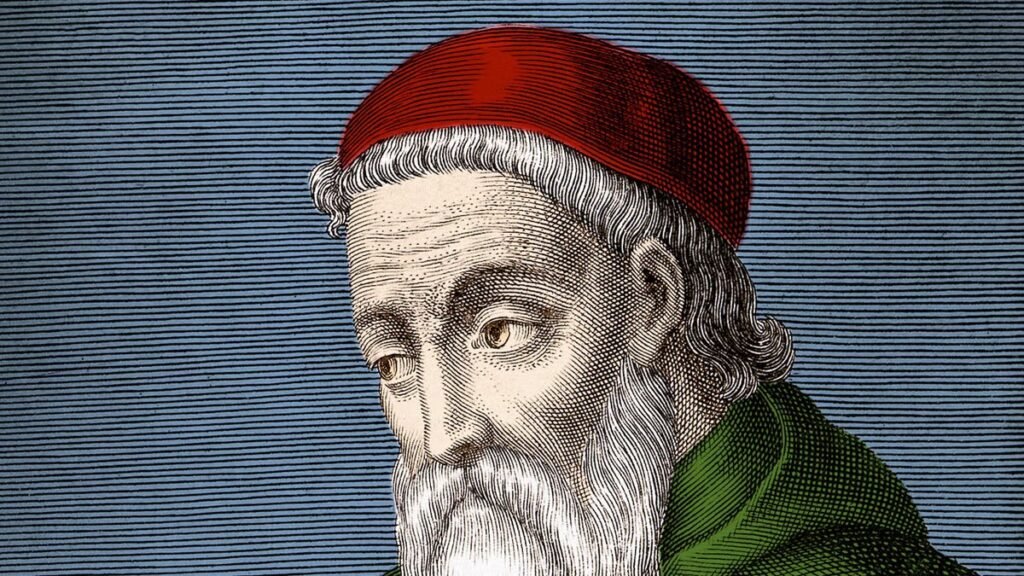
———————————–
2장 요약
콜럼버스보다 500년 앞서 바이킹들이 북아메리카에 개척지를 세웠으나 오래가지 못하고 역사 속에 묻혔다. 15세기 말, 중국으로 가는 항로를 찾으려던 콜럼버스는 스페인의 지원을 받아 서쪽으로 항해했고, 1492년 지금의 북미 바하마 제도에 도착했다. 그는 이후 세 차례의 항해를 더 이어갔지만, 끝내 자신이 아시아가 아닌 신대륙에 도착했다는 사실을 깨닫지 못했다. 결국 금과 비단을 얻지 못한 채, 병들고 스페인 왕실과의 고된 분쟁 속에서 1506년 생을 마쳤다. 그러나 그의 항해는 원주민들에게 또 다른 의미를 남겼다. 콜럼버스와 그의 부하들은 원주민들을 노예로 삼고, 폭력과 착취, 성적 학대와 학살을 자행했다. 타이노족을 비롯한 원주민들은 불과 수십 년 만에 전염병과 학대, 학살로 거의 사라졌다. 이로써 그의 “발견”은 새로운 세계의 개척이자 동시에 원주민 세계 파괴의 서막이었다. 같은 시기 아메리고 베스푸치는 이 땅이 아시아가 아니라는 점을 눈치챘다. 그는 이를 “Mundus Novus(신세계)”라 불렀다. 자신의 항해를 화려하고 장황하게 서술한 글들을 출간했으며, 자신이 콜럼버스보다 먼저 남아메리카에 도달했다는 주장이 담긴 편지까지 널리 퍼졌다. 나중에 그 편지는 위조된 것으로 밝혀졌지만, 당시 유럽인들은 이를 사실로 받아들였다. 역설적으로 지도 제작자들은 콜럼버스가 아닌 그의 이름을 따서 신대륙을 “아메리카”라 명명했다.
여러분이 생각해 볼 거리
콜럼버스는 오랫동안 ‘신대륙을 발견한 영웅’으로 기려졌지만, 오늘날 그의 이름은 재평가되고 있다. 우리는 그를 탐험 정신의 상징으로 보아야 하는가, 아니면 원주민 학살과 노예무역의 시작을 알린 인물로 비판해야 하는가? 역사 속 인물을 평가할 때, 과연 당시의 시대적 맥락을 기준으로 해야 하는가, 아니면 오늘날의 보편적 윤리 기준으로 판단해야 하는가?
———————————–
Chapter 2. China Dream, Native Nightmare: The Legacy of Columbus
The peace of the Native peoples began to unravel with the arrival of Europeans. While Christopher Columbus is generally remembered as the first European to “discover” the Americas, the truth is that some 500 years earlier, Viking seafarers had crossed the North Atlantic and established small settlements in North America.
The first European to set foot in the New World was a Viking named Bjorn, who in 986 CE, during a voyage, came upon Cape Cod Bay in present-day Massachusetts. But the true pioneer was Leif Erikson. His family’s story was anything but ordinary. His grandfather, a Norwegian banished to Iceland for murder, left behind a troubled legacy, while his father, Erik “the Red,” transformed family exile into opportunity by exploring and ruling Greenland.
In 1001, under his father’s command, Leif set sail from Greenland and established a settlement in what is now Newfoundland, Canada. But contact with Greenland proved difficult, and after his father’s death, Leif judged it impossible to maintain the colony alone. He eventually abandoned it and returned to Greenland.
Around 1004, another viking named Thorfinnur (or Thorfinn), an icelander, led his family and companions (130 people and 3 ships) to Leif’s settlement, but they too soon returned to Greenland. These Viking efforts at colonization were short-lived, and their stories faded into obscurity, unknown to other Europeans.
When Columbus set sail 500 years later, he knew nothing of the Vikings’ earlier ventures. Even if he had known, it would have mattered little, for Columbus was not searching for a new continent. He was searching for China.
Columbus was born in 1451 in Genoa, a port city in northwestern Italy. From an early age, he was an avid reader, fascinated in particular by the writings of travelers such as Marco Polo who had journeyed to China and India. Inspired by these accounts, he dreamed of reaching Asia by sailing west across the ocean. He believed that Asia lay just beyond the Atlantic.
In 1484, Columbus presented his plan to King João II of Portugal (r. 1481–1495), ruler of the kingdom most advanced in shipbuilding and navigation at the time. João, himself keenly interested in maritime exploration, was nevertheless more focused on discovering a route around the southern tip of Africa to Asia. Of course, like others of his day, he could scarcely imagine the vast size of the African continent. However, in 1488, when Bartolomeu Dias, under the king’s patronage, reached the Cape of Good Hope (the southernmost point of the African continent, marking a turning point in opening the sea route from Europe to Asia), Portugal’s efforts at maritime exploration finally bore fruit.
Rejected in Portugal, Columbus turned to Spain. At that time, Spain was rising in power under Queen Isabella (r. 1474–1504, ruler of Castile who, through her marriage to King Ferdinand II of Aragon, had set Spain on the path to unification). Yet Isabella was preoccupied with wars against the Moors (a North African Muslim people who had long ruled parts of southern Iberia) and at first paid little attention to Columbus’s proposal.
Columbus persisted. His promises of returning with fabulous quantities of gold and silk from China eventually persuaded the queen. Furthermore, wary of Portugal’s growing influence, Isabella judged that Spain too must open new routes to Asia. She granted Columbus financial backing.
In August 1492, Columbus set sail westward with three ships, his mind filled with dreams. But he miscalculated the distance across the Atlantic, and supplies quickly dwindled. After 33 arduous days at sea, he reached not China but the islands of the present-day Bahamas, just southeast of Florida.
Unaware that he had arrived in a new land, Columbus began searching for China’s treasures. Instead, he encountered the Indigenous peoples described in Chapter 1. Believing he had reached not China but India, he called them “Indians.”
Thinking China was close, he returned to Spain for reinforcements. Over the years he would make three more voyages, yet never once did he find the gold and silk he so desired. In 1506, ill and entangled in bitter legal disputes with the Spanish crown, he died still convinced that the lands he had reached were part of Asia, never knowing they lay half a world away on the far side of the globe.
Columbus is often celebrated as the “discoverer” of the New World, but the historical record reveals a darker legacy. He and his men enslaved Indigenous peoples, subjected them to violence and brutal punishments, and tore apart Native communities. The Taino, the first Indigenous people he met, suffered most. They were forced to toil in mines and on plantations. Those who failed to meet gold quotas faced the mutilation of having their hands cut off. Thousands were shipped to Spain in chains to be sold as slaves, many dying en route, and young girls were sold into sexual slavery.
When the Taino resisted on Hispaniola (the site of Columbus’s first colony, now Haiti and the Dominican Republic), Columbus ordered a ruthless crackdown. Many were killed, and dismembered bodies were displayed as a warning. Coupled with the arrival of European diseases like smallpox and measles, which ravaged populations with no immunity, the Taino people were almost entirely wiped out within a few decades.
But how reliable are these records? Historians affirm that they are, for the testimonies documenting the cruelty of Columbus and the Spanish settlers armed with guns come from multiple independent sources.
Bartolomé de las Casas, once a colonist and later a Dominican friar, became a fierce critic of Columbus and Spanish atrocities. In his A Short Account of the Destruction of the Indies (1540s), he described in detail the horrors he had witnessed.
Francisco de Bobadilla, appointed by the Spanish crown in 1500 to investigate Columbus’s rule on Hispaniola, collected testimony from settlers and Indigenous people alike. His report exposed Columbus’s cruelty and mismanagement and led to Columbus’s arrest and return to Spain in chains.
Above all, Columbus’s own writings corroborate these testimonies. On the very first day, he noted in his journal that the Taino would make “good servants” and ordered six of them seized and sent to Spain. In later letters, he repeatedly mentioned the possibility of selling Indigenous people as slaves.
Other records from his subordinates have also survived. Michele da Cuneo, for instance, vividly described the rape of an Indigenous woman by a crew member during Columbus’s second voyage. Such diverse sources complement one another, providing a multifaceted account of the grim realities of the time.
Of course, history is never simply black and white. We can only judge the past on the basis of the few primary sources that survive. This is why historians still debate how monstrous Columbus truly was. But his own words betray him: he never regarded the Indigenous peoples as equals, and he openly described plans to profit by selling them as slaves. Even if he did not personally commit every atrocity, such violence occurred under his governance, which makes him at the very least a tacit accomplice.
Some historians even call Columbus the “father of the slave trade.” Not only did he initiate the enslavement of Indigenous peoples, but in 1501, during his final year as governor of Hispaniola, a system was established to import enslaved Africans to replace the Native population that was being decimated under his exploitation. This was the beginning of the forced migration of African slaves into the Americas, and the opening chapter of a centuries-long tragedy that engulfed those who were enslaved.
Thus, the voyages we remember today as “great discoveries” were at the same time the opening act of destruction and suffering for the Indigenous world. Once enshrined in myth as a heroic name, Columbus now stands in the historical record as a figure who left behind the stark shadows of conquest, massacre, and the slave trade.
Interestingly, there was a man who grasped that the lands Columbus had reached were not Asia but a new continent. In 1499, sailing under Spanish patronage, he arrived at what is now Suriname, and in 1501, with Portuguese support, he explored the coast of present-day Brazil. Returning to Europe in 1502, he published elaborate and ornate accounts of his voyages, portraying himself as if he had commanded the expeditions, though in reality his sailing experience was minimal and much was exaggerated.
Most notably, a letter attributed to him claimed that he had reached South America as early as 1497. (By comparison, Columbus set foot on the northern coast of South America during his third voyage in 1498.) Though the letter was later proven to be a forgery, Europeans at the time accepted it as genuine. He came to be widely believed to have preceded Columbus in discovering the New World, even though Columbus had already reached the Bahamas on his first voyage in 1492.
Unlike Columbus, who died still convinced he had reached Asia, this man called the new lands Mundus Novus (“New World”). Mapmakers of the time, seizing on his name, labeled the continent “America.” His name was Amerigo Vespucci.
———————————
Chapter Two Summary:
Five centuries before Columbus, the Vikings briefly colonized North America but soon disappeared from history. In the late 15th century, Columbus, seeking a western route to China, sailed under the Spanish crown and reached the Bahamas in 1492. He would make three more voyages, yet never realized he had stumbled upon a new continent. Instead, he enslaved and exploited Indigenous peoples, and under his rule, the Taino and other Native peoples suffered brutal violence, slavery, and devastating epidemics. His voyages, hailed as “great discoveries,” also unleashed destruction. Meanwhile, Amerigo Vespucci grasped what Columbus never did—that these lands were not Asia but a “New World.” Through his writings, exaggerated though they were, he persuaded Europeans that he, not Columbus, had been the first to reach South America. In a twist of fate, mapmakers immortalized his name, christening the new continents “America.”
Points for You to Ponder:
Columbus was long celebrated as the heroic “discoverer” of the New World, but today his legacy is being reexamined. Should we still see him as a symbol of exploration, or as the man who ushered in genocide, enslavement, and the destruction of Indigenous worlds? When we judge historical figures, should we measure them by the standards of their own time, or by the moral principles we hold today?