

(*English version at the bottom)
아시아에서 얼음의 다리를 건너온 첫 이주민들: 신대륙의 시작
나는 미국 조지아 주, 애틀랜타 근교의 작은 도시에서 고등학교를 다녔다. 그곳에서는 11학년, 한국으로 치면 고등학교 2학년에 해당하는 시기가 되면 미국 역사 수업을 듣는 것이 필수였다.
첫 미국사 수업 시간은 아직도 내 기억에 또렷하다. 선생님은 미국 역사의 시작을 콜럼버스의 신대륙 ‘발견’에서부터라고 못 박았다. 이미 여러 책과 백과사전을 통해 원주민들에 대해 조금 알고 있었던 나는 선뜻 동의하기 어려웠다. 그래서 첫 수업임에도 불구하고 용기를 내어 질문을 던졌다.
“선생님, 미국의 역사는 이 땅의 첫 주인인 원주민들로부터 시작되어야 하지 않나요?”
항상 두 손을 카키 바지 앞주머니에 걸친 채 유쾌하게 강의하던, 다소 통통하고 잘 웃던 선생님의 눈빛이 순간 날카롭게 내게 꽂혔다. 선생님은 어색한 미소를 띠며 이렇게 말했다.
“물론 인디언들이 먼저 이 땅에 들어온 것은 사실이지만, 이 수업은 고고학이 아니라 미국사 수업이기 때문에 콜럼버스에서 시작하는 것이 옳단다.”
그 설명은 원주민들의 역사와 미국의 역사를 별개의 주제로 구분하는 다소 납득하기 어려운 논리였다. 거기에 그는 원주민들을 “인디언”이라 불렀는데, 이 멸시의 표현은 긴 세월 동안 원주민들의 정체성을 왜곡하는 낙인처럼 사용되어 왔다. (왜 ‘인디언’이라고 불리게 되었는지는 다음 장에서 설명하겠다.)
당시 나는 실망했지만, 후에 알게 된 사실은 이랬다. 미국의 대부분 교과서 역시 ‘콜럼버스의 신대륙 발견’을 미국 역사의 기점으로 삼고 있었던 것이다. 그러니 그 선생님이 아무 거리낌 없이 백인의 발걸음을 역사의 시작으로 믿었던 것은 어쩌면 당연한 일이었는지도 모른다. 지금도 미국의 고등학생 대다수는 여전히 미국의 역사를 콜럼버스의 신대륙 발견에서부터 배우고 있다.
그러나 미국의 역사는 그보다 훨씬 먼저, 원주민들로부터 시작된다. 이들의 조상은, 고고학자들의 연구에 따르면 대략 1만 5천 년에서 2만 년 전 사이에 아시아 대륙에서 신대륙으로의 이주를 시작한 사람들이다. 일부 학자들은 그보다 이른 2만 5천 년 전이나 3만 년 전부터 이동이 시작되었다고 보기도 하지만, 현재까지의 고고학적·유전학적 증거는 주로 1만 5천 년~2만 년 전 시기를 뒷받침한다.
이들이 이동할 수 있었던 배경에는 당시의 지리적 환경이 있었다. 마지막 빙하기 무렵, 바닷물의 수위는 지금보다 훨씬 낮았고, 오늘날의 캐나다와 미국 북부 대부분은 빙하로 덮여 있었다. 현재 아시아와 북아메리카를 가르는 베링 해협은 그 당시에는 육지로 연결되어 있었으므로, 시베리아에 살던 사람들은 매머드와 같은 대형 사냥감을 쫓아 신대륙으로 들어올 수 있었다. 이러한 작은 집단들의 이동은 바닷물 상승으로 베링 육교가 잠겨 사라질 때까지 수천 년에 걸쳐 계속되었다.
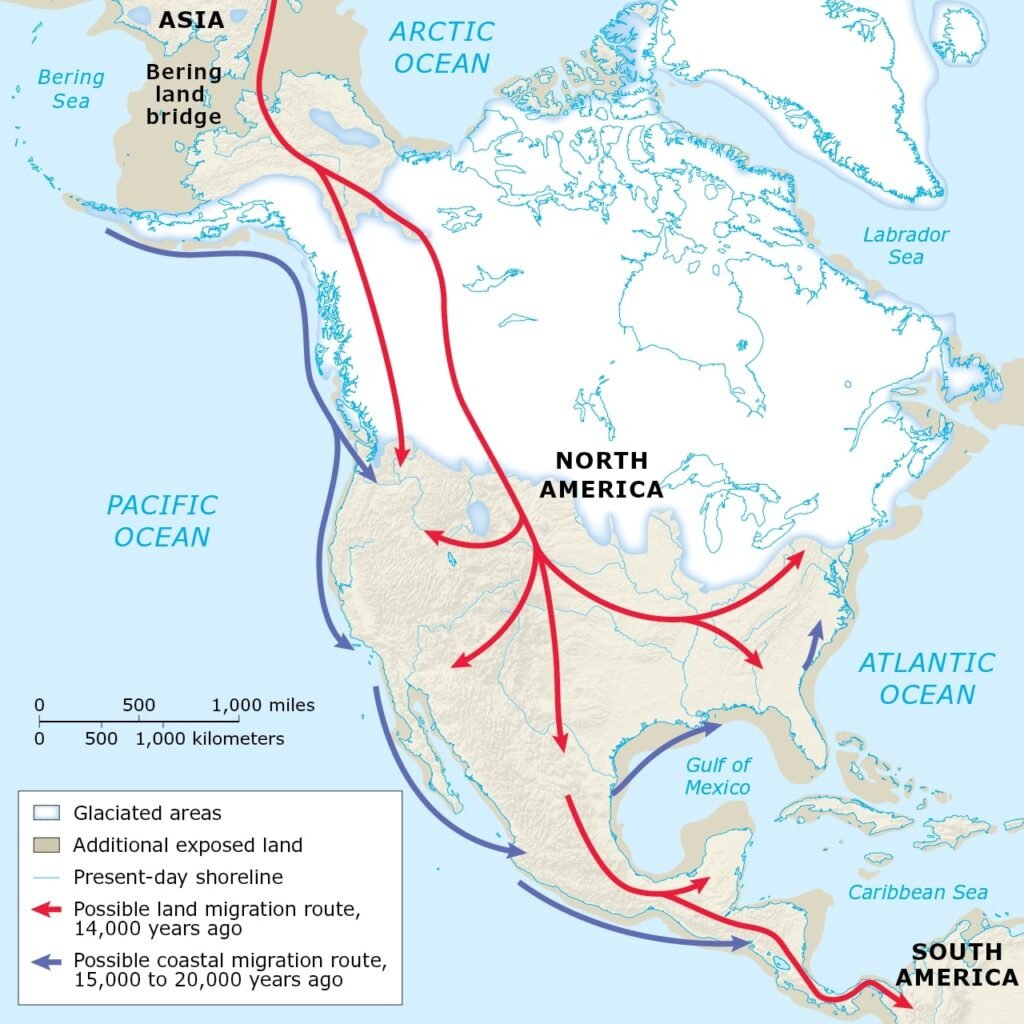
소규모 집단으로 이동한 이들은 세대를 거듭하며 신대륙 곳곳에 정착했고, 시간이 흐르면서 독자적인 언어와 문화를 발전시켰고 다양한 부족 사회를 형성했다.
기원전 2500년 무렵 농업이 시작되면서 원주민 사회는 혁명적인 변화를 맞았다. 이전에는 먹을 것을 찾아 끊임없이 이동해야 했지만, 농경은 정착을 가능하게 했고 식량 공급은 안정되었다. 이어 인구가 증가하며 사회 조직이 발전했다.
기원전 2000년경부터 오늘날의 멕시코와 중남미 지역에서는 본격적인 문명이 등장하기 시작했다. 그중에서도 가장 대표적인 문명들은 다음과 같다.
–마야(Maya, 기원전 2000년경~16세기 초, 중앙아메리카 전역에서 발전, 피라미드 신전·천문학·상형문자로 유명)
–올멕(Olmec, 기원전 1500년경~기원전 400년경, 멕시코 걸프 해안 지역의 최초 고전 문명, 거대한 석상 두상으로 유명)
–자포텍(Zapotec, 기원전 700년경~1521년, 멕시코 오악사카 지역, 몬테 알반이라는 대규모 도시 건설)
–톨텍(Toltec, 900년경~1150년경, 멕시코 중부, 군사적·종교적 영향력을 남겨 아즈텍에 큰 영향을 줌)
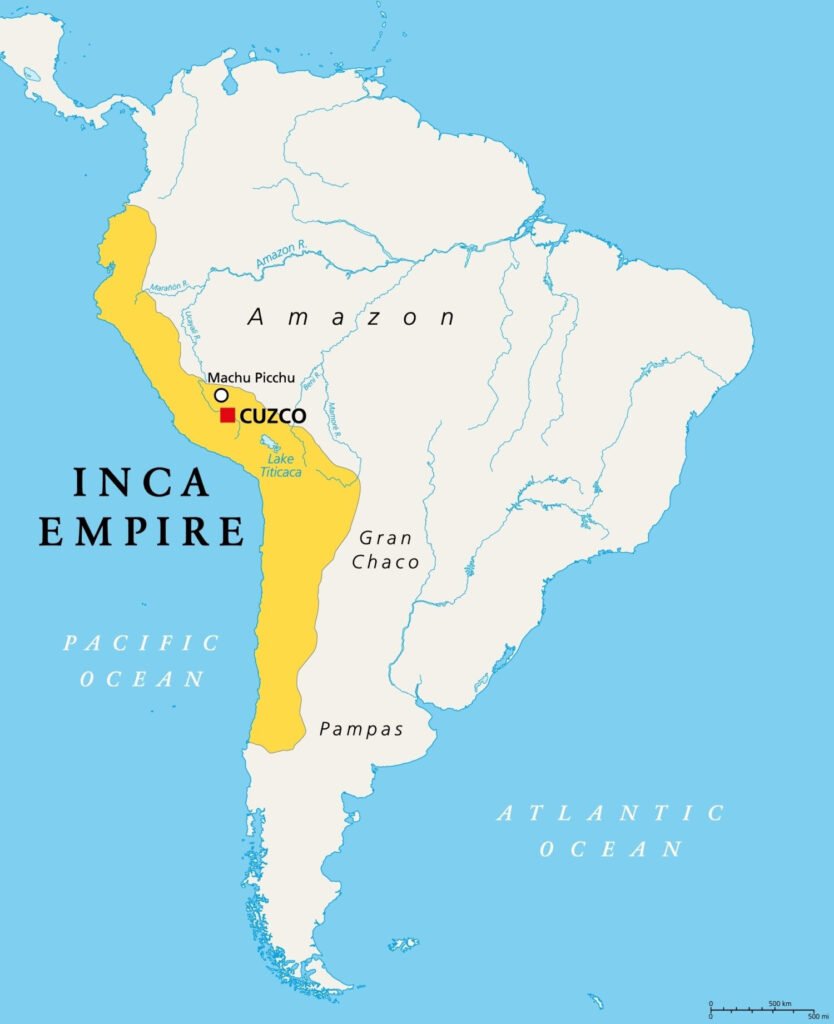
–잉카(Inca, 1200년경~1533년, 남아메리카 안데스 산맥 일대, 쿠스코를 수도로 삼아 감탄을 자아내는 도로망과 석조 건축을 남김)
–아즈텍(Aztec, 1300년경~1521년, 멕시코 중앙 고원, 테노치티틀란이라는 거대한 수도와 정교한 행정체계로 유명)

기원후 3세기 무렵에 건설된 것으로 여겨지는 테오티우아칸의 태양의 피라미드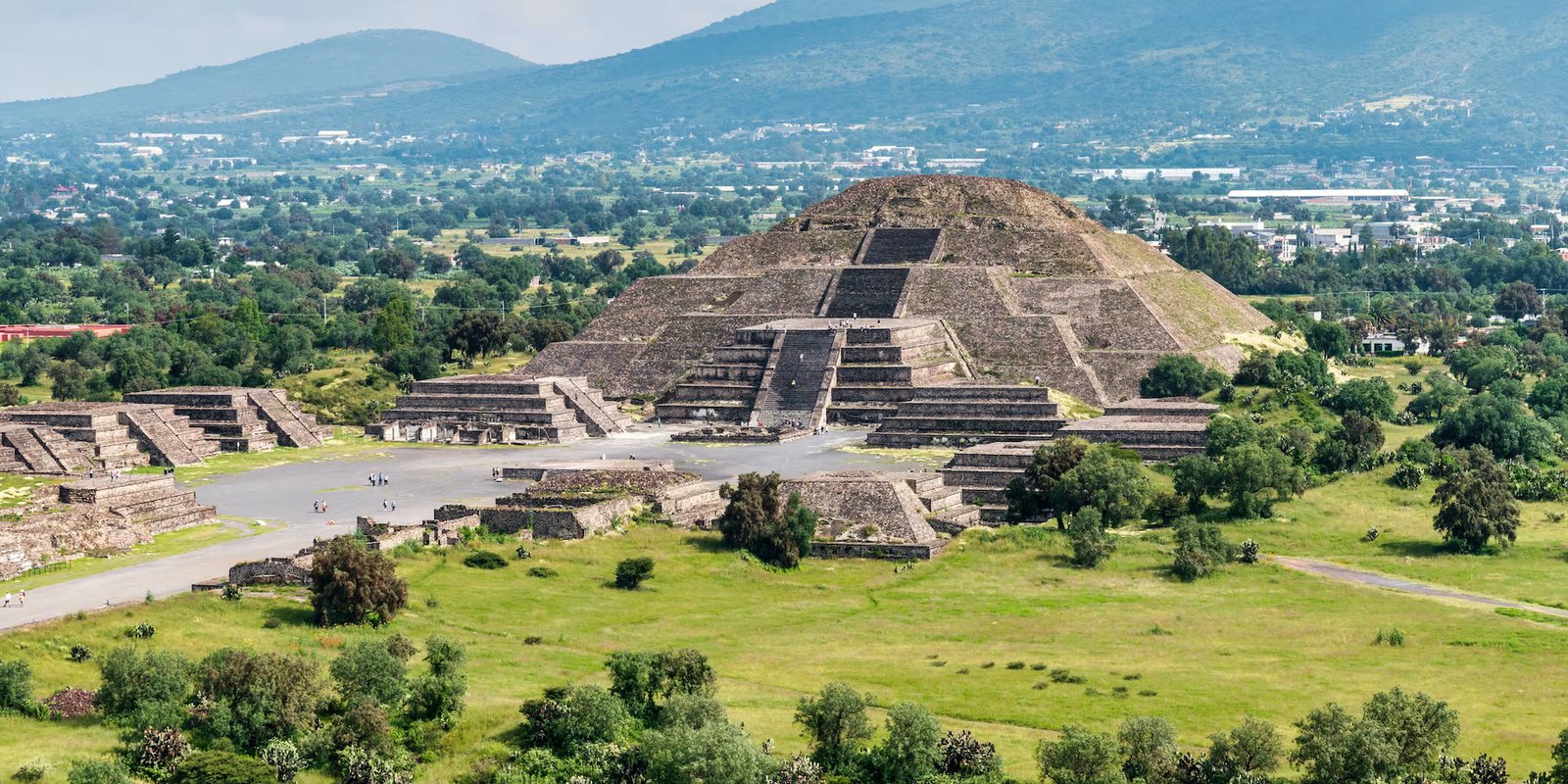
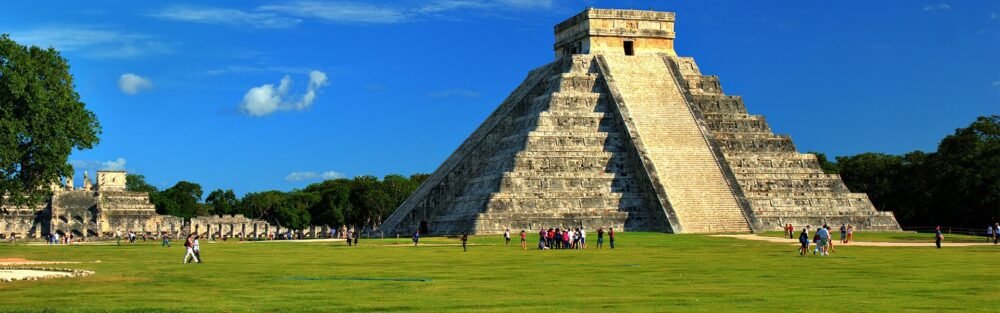
정교한 석조 기술과 섬세한 장식미가 결합된 마야의 피라미드들은 당시 마야 문명의 고도로 발전된 수준을 잘 보여준다
해발 2,430m 산맥 정상에 세워진 잉카의 요새 도시 마추픽추는, 철제 도구가 전혀 없던 시대에도 면도칼 하나 들어갈 틈조차 남기지 않은 정밀한 석조 건축과 섬세한 조각술로 건설되었다
이들은 농업 생산력이 비약적으로 향상되면서 잉여 시간을 문화·과학·예술·종교에 쏟을 수 있었고, 그 결과 오늘날에도 감탄을 자아내는 건축과 예술품을 남겼다.
대조적으로 오늘날 미국 영토에 살았던 원주민들은 중·남미의 문명에 비해 농업 기술이 상대적으로 뒤처져 있었다. 미시시피 강 유역 일부 부족이 농경 사회를 이루었으나, 대다수는 여전히 사냥과 채집에 크게 의존했다. 사계절이 뚜렷하고 겨울이 매서운 북미의 환경은 농업만으로 생존하기에 불리했기 때문이다. 이러한 조건은 북미 부족들이 아즈텍이나 잉카 같은 정교한 문명을 발전시키지 못한 이유 가운데 하나였다.
그럼에도 불구하고, 기원 1000년 무렵 북미 원주민들은 이미 300개가 넘는 언어를 발전시켰으며, 각 부족은 고유한 문화를 형성했다. 이들의 언어는 공통된 뿌리를 지녔지만, 서로는 한국어와 일본어처럼 다른 체계를 갖추고 있었다.
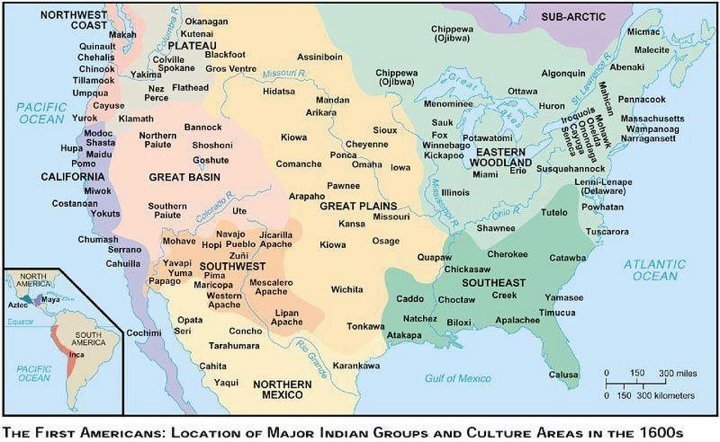
공통적인 사회적 가치와 관습도 존재했다. 예를 들어, 개인의 지위가 가족의 지위에 의해 세습되는 전통이 있었으며, 농업 중심 사회에서는 모계 사회가 발달했다. 여성들이 농경을 주도했을 뿐 아니라 땅을 소유하고 전통을 계승했다. 반면 사냥에 의존한 부족은 부계 사회를 이루었다. 수천 년 동안 원주민들의 삶은 자연과 조화를 이루며 평화롭게 이어졌다.
—————————————
1장 요약
미국사의 시작은 콜럼버스의 도래가 아니라, 훨씬 이전 아시아에서 건너온 원주민들의 정착에서 비롯된다. 고고학적·유전학적 증거는 약 1만 5천 년에서 2만 5천 년 전 사이, 빙하기의 베링 육교를 통해 최초의 이주가 시작되었음을 보여준다. 이후 아메리카 대륙 전역에서 다양한 부족 사회가 형성되었고, 중남미에서는 올멕, 마야, 자포텍, 톨텍, 아즈텍, 잉카와 같은 고도 문명이 꽃을 피웠다. 반면 북미 지역 부족들은 기후와 환경의 제약 속에서 상대적으로 단순한 농경과 수렵 사회를 이루었으나, 언어·문화·사회 제도 면에서 독자적인 발전을 이룩했다. 유럽인들이 도래하기 훨씬 이전부터 이어져 온 아메리카 원주민 문명들의 깊이와 다양성은, 이미 아메리카 대륙이 풍부하고 다채로운 역사를 지니고 있었음을 증명한다.
여러분이 생각해 볼 거리
우리가 “미국의 역사”라고 부르는 것은 어디서부터 시작하는 것이 옳을까? 교과서처럼 백인 식민지 개척자들의 정착부터 시작해야 하는가, 아니면 그 땅에서 수천 년을 살아온 원주민들의 발자취부터 시작해야 하는가?
—————————————
Chapter 1. Across the Ice Bridge from Asia: The First Migrants and the Birth of a New World
I attended high school in a small town near Atlanta, Georgia. There, every student in the 11th grade, which is equivalent to the second year of Korean high school, was required to take a U.S. history course.
The first day of U.S. history class remains vivid in my memory. The teacher firmly declared that American history began with Columbus’s “discovery” of the New World. Having already read several books and encyclopedias about Native Americans, I found this claim difficult to accept. Summoning my courage, I raised my hand and asked a question, despite it being only the first class.
“Shouldn’t American history begin with the Native peoples who were the first inhabitants of this land?”
The teacher, who usually lectured with both hands resting casually in the pockets of his khaki pants and a genial expression on his face, suddenly fixed me with a sharp gaze. With an awkward smile, he replied:
“Well, it’s true that Indians were here first, but this is not an archaeology class. This is American history, and so it must begin with Columbus.”
He explained as though Native history and American history were two separate and unrelated subjects. To make matters worse, he referred to the Indigenous peoples as ‘Indians,’ a disparaging term that for centuries has served as a stigma distorting their identity. (The origin of the term Indians will be explained in the next chapter.)
At the time, I was disappointed, but later I learned that most U.S. textbooks also began the nation’s history with Columbus’s arrival. So perhaps it was only natural that the teacher, without the slightest hesitation, believed history began with the footsteps of Europeans. Even today, the vast majority of American high school students still learn their nation’s history beginning with Columbus’s so-called discovery of the New World.
But the history of America begins long before Columbus, with the Native peoples of this land. According to archaeological research, the ancestors of today’s Native Americans were Asians who began migrating into the New World roughly 15,000 to 20,000 years ago. Some scholars argue that migration may have begun as early as 25,000 to 30,000 years ago, but the most widely supported archaeological and genetic evidence points to the period between 15,000 and 20,000 years ago.
The background for this migration lies in the geography of the Ice Age. At that time, sea levels were much lower than today, and much of present-day Canada and northern United States lay beneath massive glaciers. The Bering Strait, which now separates Asia and North America, was then a broad land bridge. This allowed people living in Siberia to follow large game animals eastward across what is now called the Bering Land Bridge into the New World. For thousands of years, small groups continued this movement until rising seas eventually submerged the land bridge.
These migrants spread gradually across the New World, settling in diverse regions and, over time, forming distinct tribal societies.
Around 2500 BCE, the introduction of agriculture transformed Native life. Freed from the uncertainty of subsistence hunting and gathering, many groups began to live in permanent settlements. As agricultural technology advanced, food supplies increased, societies stabilized, and populations grew.
By around 2000 BCE, complex civilizations had emerged in Mesoamerica and South America. Among these, the most prominent civilizations are the following:
–Maya (ca. 2000 BCE–16th century CE, spread across present-day Mexico, Guatemala, and Belize, known for pyramids, hieroglyphic writing, mathematics, and astronomy)
–Olmec (ca. 1500–400 BCE, the earliest Mesoamerican civilization along the Gulf Coast of Mexico, famous for colossal stone heads and priest-centered society)
–Zapotec (ca. 700 BCE–1521 CE, in Oaxaca, Mexico, builders of the great city of Monte Albán)
–Toltec (ca. 900-1150 CE, central Mexico, a militaristic and religiously influential culture that shaped later Aztec traditions)
–Inca (ca. 1200–1533 CE, Andes Mountains of South America, based in Cuzco, famed for their road system, administrative structure, and monumental stone architecture)
–Aztec (ca. 1300–1521 CE, central Mexican highlands, builders of the vast capital Tenochtitlán, with a sophisticated administration and powerful army)
These civilizations achieved extraordinary agricultural productivity, which freed them to develop complex political institutions, rich cultural traditions, and monumental architecture that continues to inspire awe today.
In contrast, most of the Native peoples living within the present-day United States practiced agriculture on a smaller scale and relied more heavily on hunting and gathering. While some tribes along the Mississippi River developed advanced agricultural societies, the harsh winters and marked seasonal changes of North America made survival by farming alone difficult. This environmental constraint helps explain why North American tribes did not build civilizations on the scale of the Aztec or Inca.
Nevertheless, by around 1000 CE, tribes across what is now the United States had developed over 300 distinct languages and rich cultural diversity. Their languages shared distant roots, yet differed from one another as distinctly as Korean and Japanese.
Despite this diversity, many tribes shared common social values and customs. Status was often inherited through family lines. In agricultural societies, matrilineal traditions prevailed: women performed most of the farming, owned the land, and transmitted cultural traditions. In hunting-oriented societies, however, patrilineal structures were more common.
For thousands of years, Native peoples lived in harmony with the natural world. Their lives were not only about survival but about sustaining a balanced relationship between human society and the environment.
—————————————
Chapter One Summary:
The history of the United States begins not with Columbus but with the Native peoples who first inhabited the land. Archaeological and genetic evidence indicates that their ancestors began migrating from Asia across the Bering Land Bridge roughly 15,000–25,000 years ago. These migrants spread throughout the Americas, developing diverse tribal societies. In Mesoamerica and South America, civilizations such as the Olmec, Maya, Zapotec, Toltec, Aztec, and Inca built great cities and complex governments. In contrast, most North American tribes, constrained by climate and geography, maintained simpler agricultural and hunting-based societies, though they too developed unique languages, cultures, and social systems. The depth and variety of Native American life long before European arrival reveal that the Americas already possessed a rich and multifaceted history of their own.
Points for You to Ponder:
Where should the story of “American history” truly begin? Should it start with the arrival of European settlers, as most textbooks teach, or should it include the millennia of life that had already unfolded among the Native peoples of the land?