
세상에는 아무런 특권도 보장도 없이 조용히 시작되었지만, 결국 인류의 상상력을 뒤바꾸어 놓는 삶들이 있다. 오마르 무안네스 야기의 삶이 바로 그런 이야기다.
1965년 요르단 암만의 난민촌에서 태어난 야기는 가자 지구에서 쫓겨난 팔레스타인 가정의 아이였다. 그는 물이 배급되고 불빛조차 사치였던 좁고 붐비는 방에서 어린 시절을 보냈다. 새벽 동이 트기 전 일어나 물이 끊기기 전에 통에 물을 채웠고, 깜빡이는 전구 아래에서 책을 읽다 잠들곤 했다. 글을 거의 모르던 부모는 그에게 문해력보다 더 중요한 교훈을 가르쳤다. 교육은 특권이 아니라 신성한 유산이다. 그들은 고향을 잃었지만, 지식이 언젠가 자식들의 미래를 구원하리라는 믿음만큼은 결코 잃지 않았다.
어느 날, 암만의 작은 공공도서관에서 야기는 책 속에서 분자 모형 하나를 발견했다. 공과 막대가 얽혀 있는 단순한 구조물이었다. 그러나 그 순간, 보이지 않던 세계가 모습을 드러냈다. 원자들이 우아한 질서 속에서 서로 연결되어 있었다. 그것은 단순한 과학적 호기심이 아니라, 형태를 얻은 아름다움이었다. 그 순간, 그의 마음속에는 평생을 이끌 열망이 새겨졌다. 보이지 않는 것을 만들고, 이해하고, 형태를 부여하는 일. 가족 모두 함께 지내던 방의 벽은 얇았고 공기는 무거웠지만, 그 작은 공간 안에서 한 소년의 호기심은 그 어떤 등불보다도 밝게 타올랐다.
청소년 시절, 야기는 교육에 대한 희망을 품고 홀로 바다를 건너 미국행을 결심했다. 그는 서툰 영어, 고등학교 졸업장조차 없는 상태로 낯선 땅에 발을 디뎠다. 주머니는 비어 있었지만, 배움에 대한 갈망만은 가득했다. 낮에는 슈퍼마켓에서 일하고, 밤에는 허드슨 밸리 커뮤니티 칼리지에서 공부했다. 외로움이 절망으로 변할 듯한 순간도 있었지만, 그는 배움이 곧 생존이라는 조용한 신념으로 나아갔다.
커뮤니티 칼리지를 마친 그는 뉴욕주립대 올버니 캠퍼스로 편입해 화학 학사 학위를 받았고, 이어 일리노이대학교 어바나-샴페인 캠퍼스에서 박사학위를 취득했다. 그의 발걸음 하나하나는 의지의 표현이었고, 학위 하나하나는 보이지 않는 인내의 건축물에 쌓여가는 벽돌이었다. 이후 하버드대학에서 박사후 연구원으로 일했지만, 야기는 슈퍼마켓의 바닥을 쓸던 시절의 겸손함을 잊지 않았다.
그에게 교육은 성공을 위한 수단이 아니라, 스스로에게 바치는 하나의 헌신이었다. 그는 진정한 학자는 편리를 좇지 않고, 사랑하기 때문에 배운다고 믿었다. 그리고 진정한 열정이란, 끝없는 과정과 불확실한 미래 속에서도 흔들리지 않는 마음이라 여겼다.
조용한 실험실에서 야기는 화학을 ‘발견의 학문’이 아니라 ‘창조의 예술’로 보기 시작했다. 자연은 이미 수많은 구조를 선보였다. 그러나 그는 질문했다. “인간의 정신으로 새로운 구조를 만들어낼 수는 없을까?” 이 대담한 발상에서 그가 개척한 망상화학(reticular chemistry. 분자 구성 단위를 레고 블록처럼 조립해 원하는 구조와 기능을 가진 물질을 설계하는 학문 분야)이 탄생했다. 금속 이온과 유기 분자를 정밀하게 연결해 정교한 결정 구조를 만들어내는, 완전히 새로운 화학의 길이었다.
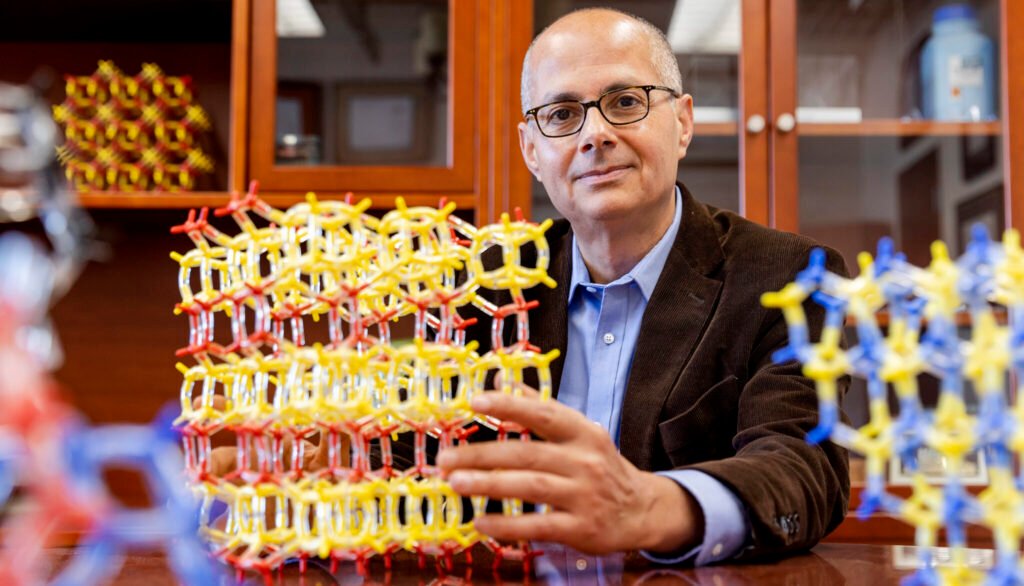
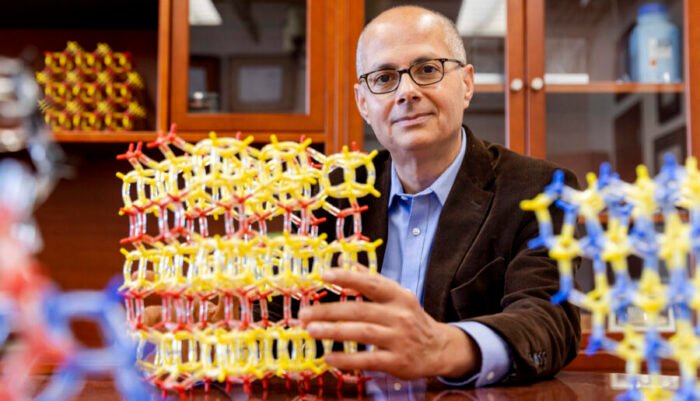
그의 대표적 창조물인 금속-유기 골격체(Metal–Organic Frameworks, MOFs)는 분자 수준에서 거대한 다공성 구조를 이룬다. 마치 원자로 지은 작은 성당처럼, 그 내부 공간은 가스나 물, 심지어 미래 기술의 꿈까지 담을 수 있을 만큼 넓다. 단 1그램의 MOF가 축구장 여러 개에 해당하는 표면적을 지닌다.
야기는 이 구조를 통해 화학이 단순히 자연을 관찰하는 학문이 아니라, 세상을 설계하는 건축학이 될 수 있음을 증명했다. 그는 이 과정을 “분자 단위의 블록으로 설계하는 일”에 비유했다. 그러나 그의 진정한 혁명은 그 너머에 있었다. 그의 구조물은 자연에 존재한 것이 아니라, 순수한 상상력에서 태어난 창조물이었다. 그는 허공에 질서를 부여하고, 원자 하나하나를 연결해 보이지 않는 조화의 구조를 세웠다.
그는 수십 년에 걸쳐 더욱 정밀한 합성 규칙을 세워 나갔다. 어떻게 하면 구조체의 안정성과 다공성을 유지하고, 기체의 이동을 원활히 하며, 붕괴를 방지할 수 있는지를 체계적으로 규명했다. 그는 또한 그 개념을 공유결합 유기 골격체(COFs)와 분자 직조(molecular weaving)로 확장했다. 강한 공유결합으로 이루어진 구조체는 물론, 분자 단위에서 직조된 구조물까지 구현해냈다.
그의 프레임워크는 자연에 존재하지 않는 합성 구조물이기 때문에, 어느 과학자든지 이를 자유롭게 조정할 수 있다. 연결체(linker)의 종류, 기공의 크기, 화학적 친화도를 바꿔가며 원하는 특성을 설계할 수 있는 것이다. 실제로 이러한 구조체들은 놀라운 응용 가능성을 보여주고 있다. 건조한 공기에서 물을 포집하고, 이산화탄소를 흡수하며, 오염 물질을 여과하고, 수소를 저장하거나 촉매 반응을 유도하는 등 다양한 분야에서 활용된다.
요컨대, 야기는 단순히 분자 구조를 탐구한 것을 넘어, 분자 구조가 펼칠 수 있는 ‘가능성의 공간’을 창조한 과학자인 것이다. 그리고 그의 연구를 통해 이산화탄소로 인한 지구 환경 위기를 완화할 새로운 가능성이 열렸다.
2012년, 야기는 미국 캘리포니아대학교 버클리 캠퍼스에 합류했다. 그는 이곳을 “과학의 니르바나(Nirvana)”라고 불렀다. 버클리는 120명이 넘는 노벨상 수상자가 학생으로, 교수로, 박사후 연구원으로, 또는 객원 교수나 연구원으로 거쳐간 세계 과학의 요람이기 때문이다. 망명과 가난 속에서 태어난 한 소년이 그 공동체의 일원이 되었다는 사실 자체가 이미 위대한 성취였다. 버클리에서 그는 여전히 연구와 교육의 경계를 넘나들며, 물질의 한계를 탐구하고 후학들에게 새로운 시야를 열어주고 있다.
그리고 2025년 10월 8일, 오랜 여정은 마침내 결실을 맺었다. 야기는 스스무 키타가와, 리처드 롭슨과 함께 노벨화학상을 수상했다. 그의 공로는 바로 MOF를 통해 완전히 새로운 분자 구조를 창조한 데 있었다. 그는 수상 소감에서 담담히 말했다. 자신이 한 일은 그저 아름다운 것을 만들고, 지적 문제를 해결하려 한 것뿐이었다고. 그 단순한 말 뒤에는 수십 년의 인내가 숨어 있었다. 수많은 실패한 실험, 밤샘 연구, 그리고 과학이야말로 예술이자 수양이라는 믿음이 있었다.
오마르 야기의 이야기는 단순히 과학의 역사에 머물지 않는다. 그것은 인간 정신이 지닌 무한한 가능성의 증언이다. 그의 삶은 우리에게, 우주에서 가장 강력한 힘은 중력도 빛도 아닌 바로 배움에 대한 의지임을 일깨워준다. 그는 명예나 보상을 위해 화학을 택하지 않았다. 원자의 대칭과 반응이 빚어내는 시적인 아름다움 자체를 사랑했다. 그 순수한 사랑이 그를 지탱했다. 난민촌에서 버클리의 연구실까지, 그는 끈기가 역경을 이긴다는 것을 증명했다. 그리고 그는 주어진 것 너머를 상상했다. 대부분의 과학자는 자연을 관찰하고 모방하지만, 그는 그 한계를 넘어섰다. 그의 MOFs, COFs는 지구 어디에도 존재하지 않았다. 그것은 인간의 정신 속에서 태어난 완전한 창조물이었다.
그의 서사는 모든 학생과 모든 꿈꾸는 이, 그리고 어린 야기처럼 희미한 불빛 아래에서 공부해야 하는 모든 아이에게 전한다. “당신의 환경이 당신을 규정하지 않는다. 당신의 호기심이 당신을 만든다.”
끝으로, 요르단 암만 난민촌의 좁은 골목에서 버클리의 찬란한 연구실까지, 오마르 야기의 삶은 그 자체로 하나의 분자 구조다. 열정과 노력, 그리고 한계 없는 지성이 서로 얽혀 하나의 거대한 격자를 이루고 있다. 그 보이지 않는 구조 속에는 그의 여정이 남긴 영원한 진리가 있다: 세상은 원자로 만들어졌지만, 그것을 지탱하는 것은 인간의 정신이다.
—————————————
(먼저 집필한 영어 원문)
Omar Yaghi: The Refugee Who Built Worlds Out of Atoms
There are lives that begin in silence, far from privilege or promise, and yet rise to shape the world’s imagination. Omar Mwannes Yaghi’s life is one of them.
Born in 1965 in Amman, Jordan, to a Palestinian refugee family displaced from Gaza, his early years unfolded in a small, crowded home where water was rationed and light was a luxury. The walls were thin, the air often heavy, but within that modest space grew a boy whose curiosity burned brighter than any lamp.
He would rise before dawn to fill containers before the pipes ran dry, then sit by a flickering bulb to read until sleep overtook him. His parents, who could barely read or write, taught him a lesson more enduring than literacy itself, that education is not a privilege, but a sacred inheritance. They had lost their homeland, but they would not lose the belief that knowledge could one day redeem their children’s future.
One afternoon, in a small public library, Omar’s young eyes caught sight of a ball-and-stick model of a molecule. Its quiet symmetry entranced him. Here was an invisible world made visible, a harmony of atoms bound in grace. It was not simply a scientific curiosity; it was beauty made tangible. That moment planted in him a lifelong yearning: to build, to understand, to give form to the unseen.
When he was a teenager, Yaghi left for the United States. A boy alone, crossing oceans for the promise of education. He arrived with halting English, no high-school diploma, and pockets as empty as his ambition was full. He found work in a supermarket by day and studied at Hudson Valley Community College by night. There were moments of loneliness so sharp they bordered on despair, yet he pressed on, guided by the quiet conviction that learning itself was a form of survival.
From community college, he transferred to the University at Albany, where he earned his bachelor’s degree in chemistry, and then to the University of Illinois at Urbana–Champaign for his Ph.D. Each step forward was an act of will. Each degree, a brick in the invisible architecture of perseverance. He would go on to Harvard as a postdoctoral fellow; but his heart never forgot the humility of those early days, sweeping supermarket floors and studying between shifts.
Education, to him, was not a staircase to prestige—it was a devotion. He believed that a true scholar studies not out of convenience but out of love, and that genuine passion endures even when the work feels endless and uncertain.
In the quiet of his laboratory, Omar Yaghi began to imagine chemistry not as discovery but as creation. Nature, after all, had already offered her designs; what if the human mind could make new ones? From that daring thought emerged reticular chemistry, a field he pioneered, one that allows scientists to link metal ions and organic molecules into intricate crystalline frameworks.
These metal–organic frameworks, or MOFs, are vast and porous at the molecular level: tiny cathedrals built of atoms, with inner spaces large enough to hold gases, water, or even the dreams of future technologies. A single gram of a MOF can have the surface area of multiple football fields. Through them, Yaghi showed that chemistry could be architectural, that we could construct, not merely observe, the material of the world.
He often described this process as designing with building blocks at the molecular scale. But the deeper truth was this: his structures were born not from nature, but from imagination. He had conjured order out of emptiness, lattice by lattice, atom by atom.
Over decades, he elaborated ever more precise synthesis rules: how to ensure the frameworks are stable, maintain porosity, allow the passage of gases, and resist collapse. He also extended the concept to covalent organic frameworks (COFs) and molecular weaving, creating structures held together by strong covalent bonds and even woven at molecular scales. Because his frameworks are synthetic constructions, designers can tailor them: changing linkers, pore sizes, chemical affinities. In practice, that has led to remarkable applications: harvesting water from arid air, capturing carbon dioxide, filtering pollutants, storing hydrogen, catalyzing reactions, and more.
In short, Yaghi was not merely a scientist who explored molecular structures; he was one who created the very “space of possibilities” that molecular structures could unfold. And through his research, a new pathway has opened to mitigate the global environmental crisis caused by carbon dioxide.
In 2012, he joined the University of California, Berkeley, a place he calls “the nirvana of science.” Indeed, Berkeley is famed for its scientific lineage: over 120 Nobel laureates are affiliated as alumni, faculty, postdocs, or visiting professors/researchers. Becoming part of that community is itself a dream fulfilled for someone born in exile and poverty. There, surrounded by brilliant colleagues and students, he continues his mission: to explore the limits of matter and to mentor those who may one day surpass him.
On October 8, 2025, that journey came full circle when Omar Yaghi was awarded the Nobel Prize in Chemistry, alongside Susumu Kitagawa and Richard Robson, for creating new molecular architectures through MOFs. When he reflected on the honor, he spoke with characteristic humility, saying he had always set out simply to build beautiful things and solve intellectual problems. Behind that understatement lay decades of perseverance—years of failed experiments, long nights of synthesis, and the patient conviction that science, at its best, is both art and discipline.
Omar Yaghi’s story is not merely about science; it is a testament to the human spirit. It tells us that the most powerful force in the universe may not be gravity or light, but the determination to learn:
Love what you study.
He did not pursue chemistry for prestige or reward; he did it because he loved the symmetry of atoms, the poetry of reaction and structure. That love sustained him when no external comfort could.
Respect the privilege of learning.
Having grown up in a home where books were scarce and teachers were distant, Yaghi revered every opportunity to learn. Education, to him, was not a commodity—it was an act of grace.
Work hard, and remain steadfast.
From refugee camps to the halls of Berkeley, he proved that perseverance outlasts circumstance. His life is a reminder that consistency, not comfort, shapes destiny.
Think beyond what is given.
Most scientists imitate nature; Yaghi imagined beyond it. His MOFs and COFs were not found in the earth’s crust; they were born in the mind. True creation, he showed, begins where observation ends.
Omar Yaghi’s journey reads like an allegory of modern exile and hope: a child displaced from his homeland, building new worlds from the smallest particles of existence. He turned adversity into insight, isolation into imagination, and hardship into harmony. He reminds us that science, at its core, is a human act, an act of wonder, of persistence, of belief in what cannot yet be seen. His story tells every student, every dreamer, every child who studies by dim light like he once did: your circumstances do not define you; your curiosity does.
In the end, from the narrow streets of Amman to the luminous laboratories of Berkeley, Yaghi’s life forms its own kind of molecular framework, a lattice of love, labor, and limitless mind. And within that invisible structure lies the enduring truth of his journey: that even in a world built of atoms, it is the human spirit that holds everything together.