
South Korea’s real estate problem is not merely an issue of the asset market. It is deeply intertwined with the future of generations, the structure of families, and the direction in which society will move. For a long time, many people have regarded a house not as a place to live, but as something to buy, in other words, an investment vehicle. As a result, the number of multi-home owners holding several properties they do not actually reside in has increased, and apartment prices in the Seoul metropolitan area, especially in Gangnam, have soared to astronomical levels. Housing prices have now far surpassed what can be reached by diligently saving one’s monthly salary.
This reality has fundamentally reshaped the lives of the younger generation. Many young people postpone or give up on marriage, and even newlyweds hesitate to have children. In a system where it takes twenty to thirty years of savings to barely afford a single apartment, planning for the future is never easy. A home has become not a symbol of comfort, but a source of anxiety.
Over the years, successive governments have attempted to address this problem. Various measures were introduced, including tighter lending regulations, heavier taxation, and expanded housing supply. But there were clear limits in reversing market expectations and speculative psychology at their root. Each policy announcement generated significant public reaction, but it ultimately fell short of structurally stabilizing apartment prices in Seoul.
In this context, President Lee Jae-myung has emphasized the need for a fundamental shift in the philosophy with which real estate is viewed. His argument is clear: the vast sums of capital tied up in property must flow into productive investments, particularly the stock market. Instead of a structure in which a small minority monopolizes wealth through rising housing prices, he envisions one in which capital invested in companies drives growth across the broader economy and its gains are shared by the entire nation.
Since taking office, he has strengthened the transparency of the stock market by advancing institutional reforms through the National Assembly, including amendments to commercial law, in order to bolster trust in the capital markets. It was a firm commitment to crack down on market manipulation through insider information or illicit practices and to establish a fair system in which ordinary investors are protected. As a result, the KOSPI, which had been hovering around the 2,400 mark before his inauguration nine months ago, surged dramatically to the 6,300 range. This miraculous achievement was made possible by the strong policy signals sent by the Lee government, which had a positive impact on market sentiment.
During the election, many reacted with cynicism when he pledged to raise the KOSPI to 5,000, and voices from conservative circles and parts of the economics community criticized the target as unrealistic. Yet considering the current efforts to resolve the so-called “Korea discount,” it is reasonable to believe that even a KOSPI 10,000 era may be within reach.
At the same time, President Lee has pursued policies aimed at stabilizing the real estate market. By strengthening property holding taxes and capital gains taxes on multi-home owners, he has sought to encourage properties not intended for actual residence to be placed on the market. The strategy is to restructure incentives so that owning multiple homes no longer yields financial advantage, thereby promoting price stability. It is a clear declaration of intent to return housing from a speculative asset to its proper role as a means of living.
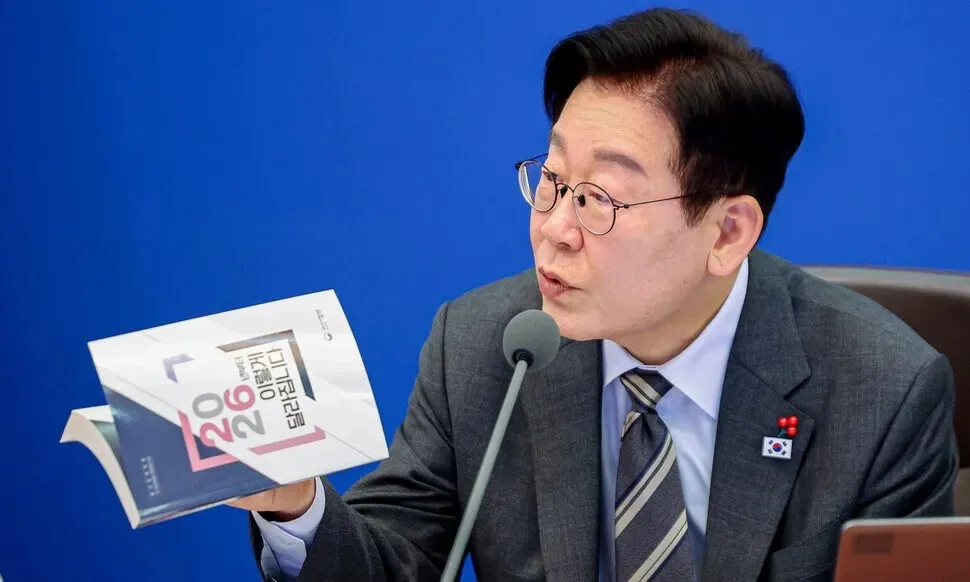
He also communicates with the public on a daily basis through social media, particularly X. Whenever certain media outlets advance arguments centered on asset holders, he responds directly with rebuttals explaining the purpose of his policies. Beyond routine briefings, this represents a new mode of communication in which a national leader personally persuades the public of his economic philosophy. In particular, his message that “In a capitalist society, it is one’s freedom to buy as many houses as one wishes, but one must take responsibility for the social problems that arise from that behavior” has resonated deeply with many citizens. His current approval ratings attest to the public support for these policies. It is especially encouraging that among people in their sixties and seventies, who have long tended to view the progressive camp negatively, positive evaluations now outpace negative ones.
Recently, signs of change have also been detected among experts. As listings from multi-home owners increase and transaction volumes adjust, expectations are forming that apartment prices in Seoul may stabilize from their peak levels. Of course, the market remains complex and full of variables, making it difficult to resolve all issues in the short term. But it is clear that the deeply rooted belief that “Seoul housing prices can never be brought under control” is gradually beginning to waver.
Real estate policy is not simply about lowering prices. It is about redirecting the flow of capital and reshaping the structure of society as a whole. President Lee Jae-myung’s approach is a bold attempt to channel stagnant capital locked in property into productive sectors, thereby creating a virtuous cycle in the economy. If this structural transformation succeeds, the Korean economy will not only strengthen its fundamentals but also enter a new phase of advancement. He deserves applause for his dedication to building a common-sense country where ordinary people like me can dream of a better life.
—————————
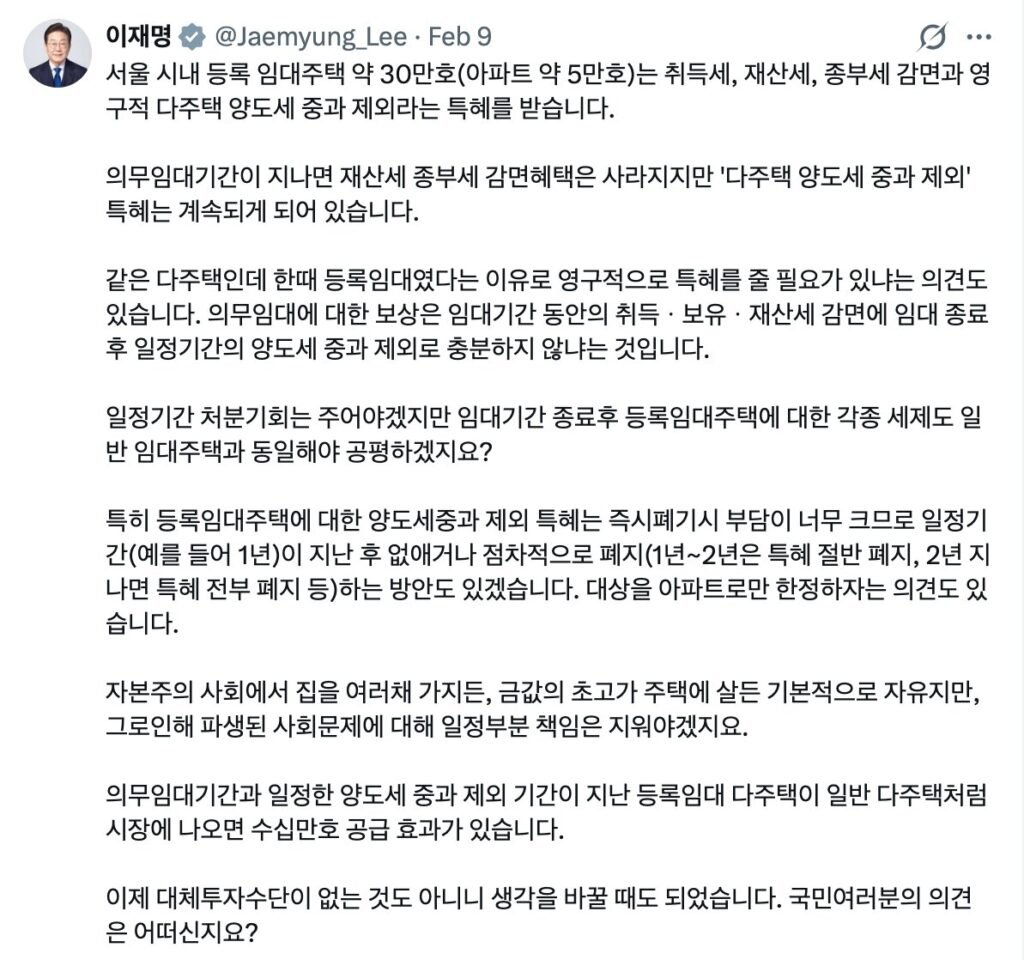
Among many, this is one of the messages he posted on X:
Approximately 300,000 registered rental housing units in Seoul (including about 50,000 apartments) receive preferential treatment such as reductions in acquisition tax, property tax, and comprehensive real estate tax, as well as a permanent exemption from the heavy capital gains tax imposed on multi-home owners.
After the mandatory rental period ends, the reductions in property tax and comprehensive real estate tax disappear, but the special exemption from the heavy capital gains tax for multi-home owners continues indefinitely.
Some argue that there is no need to grant permanent preferential treatment simply because the properties were once registered rentals, given that they are still multi-home holdings. They contend that compensation for fulfilling the mandatory rental period is sufficiently provided through reductions in acquisition, holding, and property taxes during the rental period, along with a temporary exemption from the heavy capital gains tax after the rental period ends.
While it may be necessary to allow a certain period for property disposal, it would be fair for the tax system applied to registered rental housing to be aligned with that of ordinary rental housing once the rental period has expired.
In particular, immediately abolishing the special exemption from the heavy capital gains tax for registered rental housing could impose excessive burdens. Therefore, one option would be to eliminate it after a certain period, for example one year, or to phase it out gradually, such as abolishing half of the benefit after one to two years and eliminating it entirely after two years. Some also suggest limiting the measure to apartments only.
In a capitalist society, it is fundamentally a matter of freedom to own multiple homes or to live in ultra-luxury residences worth their weight in gold. However, it is also reasonable to require a certain degree of responsibility for the social problems that arise as a result.
If registered rental properties held by multi-home owners are released onto the market after both the mandatory rental period and a defined exemption period for the heavy capital gains tax have passed, it could have the effect of increasing housing supply by hundreds of thousands of units.
There are no longer no alternative investment options available. Perhaps it is time to change our thinking. What are your thoughts, citizens?